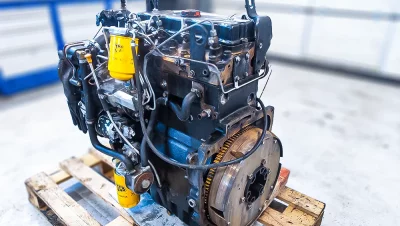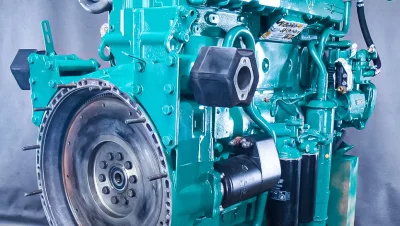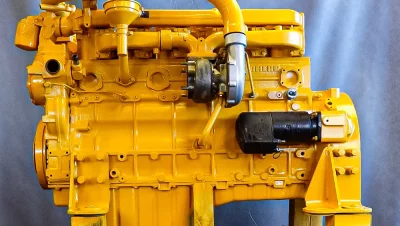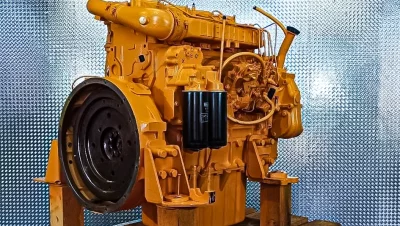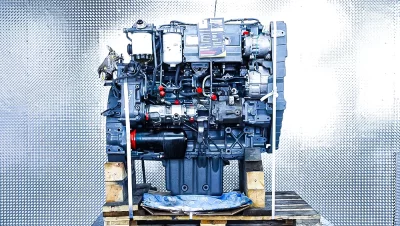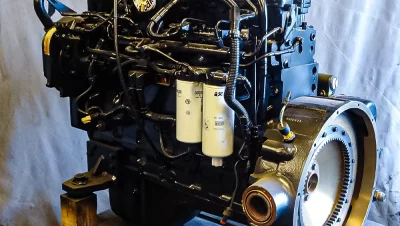


Deutz TCD 4.1 L4 Engine Overhaul in a Mecalac AS 1600 Telescopic Handler
Power loss, excessive smoke, and increasing oil consumption in a telescopic handler are signals that should not be ignored[cite: 1]. In the case of the Mecalac AS 1600, a thorough diagnostics of the Deutz TCD 4.1 L4 engine was necessary, as the deteriorating performance parameters began to affect the machine's daily operation[cite: 1]. Our service center performed initial diagnostics, power unit removal, complete component verification, and an engine overhaul, followed by testing the unit on an engine dynamometer upon completion of the work[cite: 1].
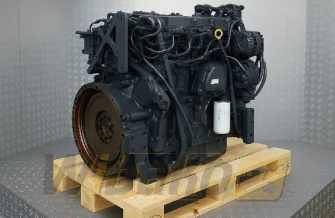
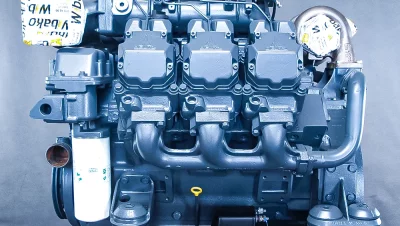
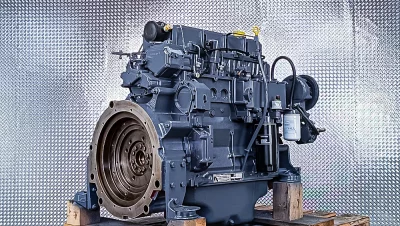
The Mecalac AS 1600 is a telescopic handler designed for work requiring high mobility and precise execution of multiple working functions[cite: 1]. In such machines, the internal combustion engine operates under varying load conditions, making its technical condition directly significant to the overall efficiency of the machine[cite: 1]. The power unit is a Deutz TCD 4.1 L4, a four-cylinder diesel engine used in off-highway machinery[cite: 1].
WIBAKO carries out overhauls and repairs of diesel engines used in construction, agricultural, and municipal machinery[cite: 1]. For Deutz engines, properly identifying the root cause of the problem is particularly important, as similar symptoms can be linked to the fuel system, turbocharging, as well as mechanical wear of the power unit[cite: 1]. Therefore, before deciding on an overhaul, we performed diagnostics on the engine installed in the Mecalac AS 1600[cite: 1].
Diagnostics of the Deutz TCD 4.1 L4 Engine in the Mecalac AS 1600
The first stage of work was engine diagnostics directly on the machine[cite: 1]. This allows for evaluating the power unit's behavior under real working conditions and determining whether the symptoms reported by the operator actually indicate a mechanical issue[cite: 1]. In this case, we paid special attention to the gradual drop in engine performance, increased oil consumption, and smoking[cite: 1].
We began diagnostics by evaluating the basic operating parameters of the unit[cite: 1]. We checked the engine starting behavior, idle operation, and performance during RPM increases[cite: 1]. Next, we observed the engine's reaction to load[cite: 1]. It was also important to check whether the symptoms occurred regardless of the unit's temperature or worsened after reaching operating temperature[cite: 1].
The next step was checking the engine oil level and condition, as well as the filters[cite: 1]. Verification of the lubrication system is important when wear of the crank-piston assembly components is suspected[cite: 1]. We checked for any signs of excessive oil consumption and observed the engine during operation[cite: 1]. Simultaneously, we inspected the intake system and air line connections, as an intake leak or malfunction in the turbocharging system can cause symptoms resembling mechanical problems[cite: 1].
After performing basic diagnostics, we proceeded with measurements to more accurately determine the condition of the unit[cite: 1]. When wear of cylinders and pistons is suspected, measuring compression pressure and evaluating cylinder tightness are particularly important[cite: 1]. These allow us to determine whether the pistons, rings, and cylinder surfaces can provide proper sealing of the combustion chamber[cite: 1].
The diagnostic results indicated mechanical engine wear[cite: 1]. Symptoms such as compression drop, increased oil consumption, and smoking served as the basis for deciding to remove the unit and perform a detailed verification in the workshop[cite: 1]. Only disassembling the engine makes it possible to accurately determine the scope of necessary work and decide which components can be reused and which require replacement or reconditioning[cite: 1].
Removing the Engine from the Mecalac AS 1600 Telescopic Handler
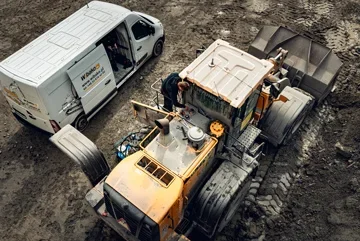
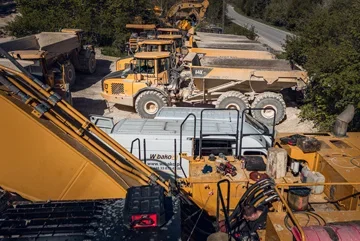
After confirming the need for an overhaul, we proceeded to prepare the Mecalac AS 1600 for engine removal[cite: 1]. Removal of the power unit is carried out by our mechanics directly at the customer's site or where the machine is parked[cite: 1]. To extract the engine, a crane provided by the customer is always used, allowing the unit to be safely lifted and guided out of the engine compartment[cite: 1].
Before lifting the engine, we thoroughly prepared all components that needed to be disconnected[cite: 1]. First, systems whose hoses and connections remain in the machine were secured[cite: 1]. We paid special attention to cooling system hoses, air lines, and the electrical wiring[cite: 1]. Each connection was properly marked to maintain correct routing of lines and connectors during later reassembly[cite: 1].
Next, we disconnected auxiliary components and mechanical connections[cite: 1]. The power unit mounts were removed, and before lifting the engine, we checked to ensure no line, ground strap, electrical harness, or auxiliary component remained attached to the machine[cite: 1]. Such preparation is especially important in telescopic machines, where space around the engine can be limited[cite: 1].
After releasing all mounts, the engine was suspended using the crane and carefully guided out of the compartment[cite: 1]. The mechanics monitored the position of the unit during lifting to prevent damage to lines, radiators, frame components, or other parts of the Mecalac AS 1600[cite: 1].
After removal, the engine was transported to our headquarters in Kojszówka[cite: 1]. There, the next stage of work began - a thorough disassembly and verification of all Deutz TCD 4.1 L4 components[cite: 1].
Verification of the Deutz TCD 4.1 L4 Engine in the Workshop
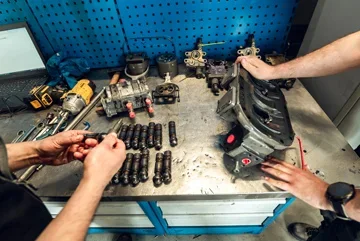
Upon arrival of the engine at the workshop, we do not automatically replace all parts[cite: 1]. First, the unit is disassembled, and individual parts are washed, inspected, and measured[cite: 1]. This approach allows us to determine the actual scope of the overhaul and avoid replacing components that can still be used after a positive evaluation[cite: 1].
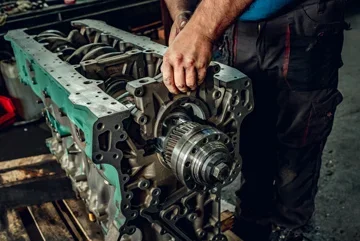
In the case of the Deutz TCD 4.1 L4, we paid special attention to the crank-piston system, as prior diagnostics indicated cylinder and piston wear[cite: 1]. After disassembling the unit, we were able to compare the condition of individual components with the measurement results obtained before removal[cite: 1].
The cylinders underwent a thorough inspection for wear on working surfaces[cite: 1]. We checked their visual condition and took measurements to determine the degree of wear[cite: 1]. Special attention was paid to areas experiencing the highest loads during piston movement[cite: 1]. The surface interacting with the piston rings was also checked[cite: 1].
Pistons were inspected for signs of wear, overheating, and surface damage[cite: 1]. Piston rings and their fit with the pistons were also verified[cite: 1]. In an engine showing increased oil consumption, ring condition is of vital importance, as improper operation can cause oil to enter the combustion chamber[cite: 1].
At the same time, we inspected the crankshaft[cite: 1]. This includes visual surface inspection, checking for signs of overheating or excessive wear, measuring shaft runout, measuring journals, and checking oil passages[cite: 1]. The crankshaft is one of the most critical engine components, so its reuse can only occur after confirming proper technical condition[cite: 1].
Connecting rods were checked as well[cite: 1]. Verification includes visual assessment for cracks, wear, and signs of overheating, as well as checking for twist and longitudinal bend[cite: 1]. Connecting rod fasteners are also inspected[cite: 1].
Verification of the Deutz Engine Cylinder Head
Inspecting the engine cylinder head was a separate phase[cite: 1]. During an engine overhaul, merely visual assessment of its surface is insufficient[cite: 1]. The cylinder head must be checked for continued serviceability[cite: 1]. Valve seats, clearances, and tightness are among the elements controlled[cite: 1].
Pressure testing of the cylinder head involves submerging it in heated water, applying compressed air, and observing whether air bubbles escape from the tested component[cite: 1]. This allows for the detection of leaks and cracks that might not always be noticeable during a standard visual inspection[cite: 1].
Following verification, we established the scope of work required for the cylinder head[cite: 1]. Components requiring repair were prepared for reconditioning[cite: 1]. Cylinder head reconditioning involves resurfacing (skimming), and depending on the degree of wear, valve guides and valves are replaced[cite: 1].
Crank-Piston Assembly Repair
The most important part of the Deutz TCD 4.1 L4 overhaul was repairing the crank-piston assembly[cite: 1]. This set of components is directly responsible for converting energy generated during fuel combustion into rotational motion of the crankshaft[cite: 1]. Its proper condition affects engine power, oil consumption, cylinder sealing, and running smoothness[cite: 1].
After taking measurements, we determined the condition of the crankshaft, connecting rods, pistons, rings, liners, and bearings[cite: 1]. Components with wear exceeding permissible tolerances were designated for replacement or reconditioning[cite: 1]. For the crankshaft, reconditioning means grinding to the appropriate undersize, provided the condition of the part allows for further use[cite: 1].
During the assembly of the crank-piston system, we pay strict attention to the cleanliness of all surfaces and proper fitting of mating parts[cite: 1]. Oil channels are thoroughly cleaned, as even minor debris left over from previous operation can negatively impact the durability of the freshly overhauled unit[cite: 1].
New components are installed according to the technical specifications required for the given unit[cite: 1]. Proper clearances and correct orientation of individual parts are checked[cite: 1]. This ensures that once the overhaul is complete, the crank-piston assembly operates correctly under engine load[cite: 1].
Cylinder Head Reconditioning and Assembly
After preparing the crank-piston components, we moved on to work on the cylinder head[cite: 1]. All surfaces were properly prepared, and parts designated for replacement were swapped for new ones[cite: 1]. Maintaining proper surface geometry and valve train tightness is crucial for the cylinder head[cite: 1].
Upon completing reconditioning, the cylinder head was verified once more[cite: 1]. We checked surface condition, valve components, and sealing integrity[cite: 1]. Only a positive test result permitted installation of the cylinder head onto the reassembled engine[cite: 1].
Verification of Engine Accessories
An engine overhaul is not limited to replacing internal block components[cite: 1]. During our work, we also inspect engine accessories, as their condition directly affects engine performance after installation in the machine[cite: 1].
The turbocharger is among the components verified[cite: 1]. Radial and axial rotor clearances are measured[cite: 1]. This helps determine whether the turbocharger can be reused or requires further repair[cite: 1].
Electrical and electromechanical components, including the starter motor and alternator, are checked[cite: 1]. Their proper operation is especially critical after installing the engine, as issues with electrical power or starting could complicate proper engine startup after overhaul[cite: 1].
During reassembly, we also inspect the condition of hoses and connections[cite: 1]. Components showing wear or damage are prepared for replacement[cite: 1]. The goal is not just starting the engine itself, but preparing the entire unit for safe operation in the Mecalac AS 1600[cite: 1].
Professional Reassembly of the Deutz TCD 4.1 L4 Engine
Following verification and component preparation, we began reassembling the Deutz TCD 4.1 L4[cite: 1]. Assembling an engine after overhaul requires adhering to a specific sequence of work and inspecting every step[cite: 1]. It is not merely a mechanical joining of parts[cite: 1]. Every component must be placed in its exact position and properly prepared for further operation[cite: 1].
Before beginning assembly, all mating surfaces were thoroughly cleaned[cite: 1]. We checked the condition of fasteners and prepared new replacement parts required during the overhaul process[cite: 1]. During assembly, lubrication system connections and oil passage clearance are also verified[cite: 1].
Once the crank-piston assembly is put together, remaining engine components are installed, including the cylinder head and auxiliary equipment[cite: 1]. Work quality is monitored at every stage[cite: 1]. We pay special attention to parts where improper assembly could result in oil leaks, coolant leaks, or air intake issues[cite: 1].
After assembly, the engine is prepared for startup and testing[cite: 1]. Required operational fluids are topped off, correct filters are installed, and all connections are verified[cite: 1]. Prior to the first start, we also inspect the cooling system, lubrication system, air intake, and electrical system[cite: 1].
Deutz TCD 4.1 L4 Engine Dynamometer Testing
One of the most crucial parts of the entire overhaul process is the engine dynamometer test[cite: 1]. WIBAKO has the capability to test overhauled units under load conditions before reinstalling them into the machine[cite: 1]. This allows us to evaluate engine behavior not only at no-load idle, but also when the unit actually needs to transfer power[cite: 1].
Dynamometer testing verifies proper engine functionality after reassembly[cite: 1]. This is particularly essential for units destined for construction machinery, as a telescopic handler engine operates under variable conditions[cite: 1]. Simply starting an engine and idling it does not yield the level of data obtained from a controlled test under load[cite: 1].
Upon starting, the overhauled engine initially runs under light conditions[cite: 1]. Overhauled units are scheduled to run for a minimum of 16 operating hours (mth) at approximately 20-30% nominal load[cite: 1]. This allows overhauled components to bed in safely while basic operating parameters are monitored[cite: 1].
During the dyno run, engine behavior is monitored across various RPMs and load levels[cite: 1]. We track operational stability, temperature, oil pressure, and cooling system behavior[cite: 1]. We also check for unwanted leaks or abnormal noises[cite: 1].
After the initial break-in under light conditions, if the engine maintains core parameters, we move on to higher load tests[cite: 1]. The unit is repeatedly loaded to evaluate performance across different operational points[cite: 1]. This test exposes issues that might go unnoticed during a brief unloaded run[cite: 1].
The engine dynamometer also evaluates engine response to load changes[cite: 1]. In practice, this means verifying whether the unit properly picks up and stabilizes performance during changing conditions[cite: 1]. This is vital for an engine destined for a Mecalac AS 1600, where an operator may simultaneously run driving and attachment functions[cite: 1].
The dyno test serves as an additional quality control check of the completed repair[cite: 1]. Should any irregularities arise during testing, we can address them before installing the engine back in the machine[cite: 1]. This minimizes the risk of having to remove the unit from the telescopic handler again and ensures thorough preparation for work[cite: 1].
Only after passing tests with positive results is the engine prepared for transport and installation in the Mecalac AS 1600[cite: 1]. For the customer, this offers an extra level of assurance, knowing the unit was verified before returning to service[cite: 1].
Engine Installation in the Mecalac AS 1600
Following the overhaul and successful dyno testing, we proceeded to install the Deutz TCD 4.1 L4 into the Mecalac AS 1600 telescopic handler[cite: 1]. Installation is performed by our mobile service, eliminating the need for the customer to arrange transport for the entire machine to our workshop[cite: 1]. When needed, our mechanics perform removal and installation directly where the machine is located, while the engine itself is transported to our Kojszówka facility for the overhaul[cite: 1].
Before moving the unit into the engine bay, we checked the preparation of all mounting points[cite: 1]. The engine was positioned relative to the mounts and carefully lowered using the crane provided by the customer[cite: 1]. During this operation, mechanics monitored clearances to adjacent components and verified proper unit alignment[cite: 1].
Once seated, we installed the engine mounts and all required connections[cite: 1]. Special care was given to cooling system installation[cite: 1]. Lines were connected along correct paths, and joints were inspected for leaks[cite: 1]. This is important, as even a minor cooling system leak can lead to fluid loss and overheating under load[cite: 1].
We also thoroughly inspected the intake system[cite: 1]. Air ducts and their connections must be properly installed and airtight[cite: 1]. For a turbocharged engine, intake connection quality directly impacts performance[cite: 1]. Consequently, all connections were verified post-installation[cite: 1].
Next, the electrical wiring, remaining hoses, and auxiliary components were reconnected[cite: 1]. Every connection is checked prior to test-starting[cite: 1]. Replaced or prepped parts must function seamlessly with the Mecalac AS 1600 system to ensure proper operation of the engine and machine functions[cite: 1].
Before startup, fluid levels and filters were double-checked[cite: 1]. We inspected all points where connections might have unsealed during installation[cite: 1]. Only after completing these checks successfully did we perform the initial engine start in the machine[cite: 1].
Following startup, we monitored the Deutz TCD 4.1 L4 operation and checked basic parameters[cite: 1]. We paid close attention to operating temperature, oil pressure, RPM stability, and any potential leaks[cite: 1]. Cooling system and air intake performance were also monitored as RPM increased[cite: 1].
The final phase involved machine testing carried out alongside the operator[cite: 1]. This permits evaluating the engine not just while stationary, but under actual operational conditions of the Mecalac AS 1600[cite: 1]. The operator performs core machine functions while our technicians observe engine response to variable loads and integration with other components[cite: 1].
We evaluate performance during load increases, hydraulic system operation, and travel[cite: 1]. Connection tightness is rechecked once the engine reaches operating temperature[cite: 1]. This step is crucial, as certain leaks only manifest after the system reaches full operating temperature and pressure[cite: 1].
Upon successful completion of testing and confirming leak-free, proper engine operation, installation is finalized[cite: 1]. Completed work is documented, and the customer receives guidelines for further maintenance of the overhauled unit[cite: 1].
Post-Overhaul Engine Maintenance
An engine overhaul is just the beginning of its next operational cycle[cite: 1]. To ensure proper start of service after rebuilding, we recommend performing the first service inspection after 50 mth[cite: 1]. This inspection is carried out by our mobile service team traveling to the customer[cite: 1].
The 50 mth check goes beyond a simple filter change[cite: 1]. Our mechanics evaluate the overall condition of the engine and accessories after its initial period of service[cite: 1]. Connections, system tightness, smooth operation, and potential signs of leaks that may have surfaced during regular operation are inspected[cite: 1].
The first filter change at 50 mth is a crucial element of post-overhaul maintenance[cite: 1]. Subsequent inspections are recommended every 250 mth, but no less frequently than every 3 months[cite: 1]. Regular servicing helps detect potential issues earlier and maintains the unit in optimal technical condition[cite: 1].
Deutz TCD 4.1 L4 - An Engine Used in Off-Highway Machinery
The Deutz TCD 4.1 L4 is a power unit found in numerous applications requiring a compact diesel engine designed for off-highway use[cite: 1]. Engines from this family can be found in construction equipment, loaders, telescopic handlers, material handling machinery, and other industrial tools[cite: 1].
Because of this, repairing a Deutz engine requires looking beyond just the model number[cite: 1]. When ordering parts or planning an overhaul, the exact engine and machine configuration matters[cite: 1]. The engine number, nameplate, machine serial number, and available technical documentation help correctly identify installed components[cite: 1].
WIBAKO provides Deutz diesel engine servicing and overhauls for units operating in construction and off-highway machinery[cite: 1]. Depending on engine condition, the scope of work can include diagnostics, removal, complete verification, reconditioning or replacement of worn components, installation, and engine dynamometer testing[cite: 1].
Construction Machinery Service and Deutz Engine Overhauls
The Mecalac AS 1600 case demonstrates why symptoms like smoking, high oil consumption, or power loss warrant starting with accurate diagnostics[cite: 1]. Early problem identification determines whether the cause lies in the fuel system, intake, turbocharger, or internal mechanical components[cite: 1].
For this telescopic handler, diagnostics pointed to crank-piston assembly wear[cite: 1]. After disassembly, we confirmed component condition and carried out a comprehensive overhaul of the Deutz TCD 4.1 L4[cite: 1]. The unit was reassembled, started, and load-tested on the engine dynamometer before being installed in the Mecalac AS 1600[cite: 1].
A comprehensive approach eliminates the risk of an engine returning to work right after startup without thorough testing[cite: 1]. Dyno testing enables early verification of the unit, while post-installation tests confirm proper synergy between the engine and the specific machine[cite: 1].
Summary of the Deutz TCD 4.1 L4 Overhaul in the Mecalac AS 1600
The engine overhaul in the Mecalac AS 1600 telescopic handler encompassed the complete process - from initial machine diagnostics, engine removal and workshop transport, through component verification, repair, dyno testing, to reinstallation[cite: 1].
The primary goal was eliminating power loss, high oil consumption, and smoking[cite: 1]. Disassembly confirmed wear within the crank-piston assembly[cite: 1]. The completed repair restored the Deutz TCD 4.1 L4 for continued service in the Mecalac AS 1600[cite: 1].
Quality control made up a major part of the process[cite: 1]. Inspecting individual parts, cylinder head testing, crankshaft, connecting rod, piston, ring, cylinder liner, and accessory checks defined the true scope of the overhaul[cite: 1]. The engine was then reassembled and tested on the engine dynamometer[cite: 1].
After installation in the machine, we performed additional leak checks and operational tests with the operator[cite: 1]. This verified the performance of the Deutz TCD 4.1 L4 under real working conditions of the Mecalac AS 1600, rather than strictly on a workshop bench[cite: 1].
If an engine in your construction machine begins losing power, consuming excess oil, smoking, or running rough, start with professional diagnostics[cite: 1]. WIBAKO provides Deutz engine overhauls, diagnostics, removals, installations, and engine dynamometer testing[cite: 1]. Our mobile service team can also travel directly to where your machine is parked[cite: 1].
Related Services and Information
Construction machinery service
Mobile service for construction machinery
Contact us
Do you need an overhaul for a Deutz TCD 4.1 L4 engine or service for a Mecalac AS 1600 telescopic handler? Contact WIBAKO - we perform comprehensive diagnostics, engine overhauls, machine installation, and engine dynamometer testing.