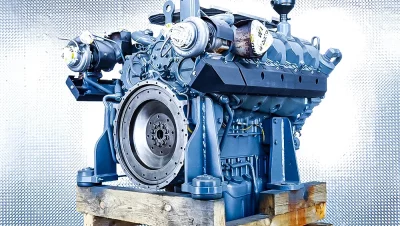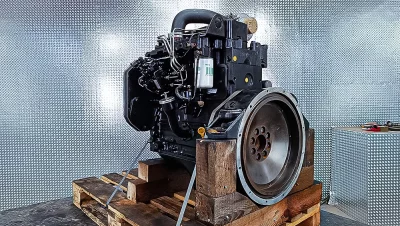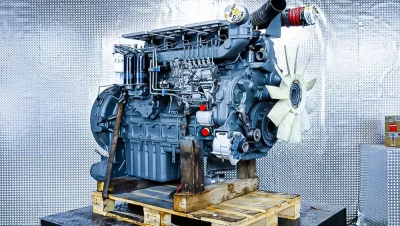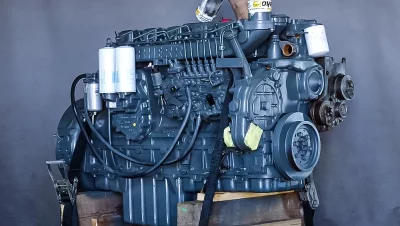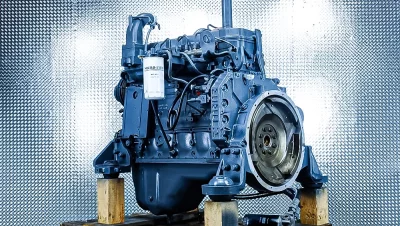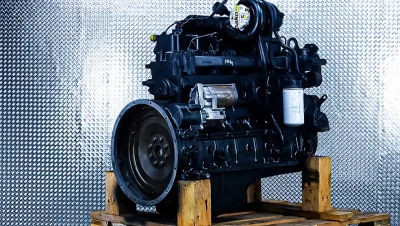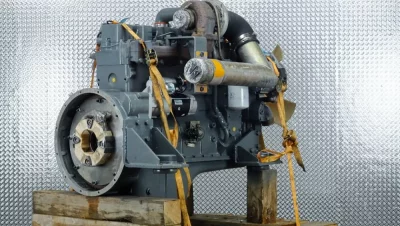


John Deere 6068HT080 Engine Overhaul in a John Deere W540 Straw Walker Combine Harvester
The engine starts losing power, the combine works with increasing difficulty, and oil consumption grows. In the case of a machine operating during a short and intense harvest season, there is no room for accidental repairs. This is how the project regarding the John Deere W540 straw walker combine harvester with a John Deere 6068HT080 engine began. The need for an overhaul resulted from the progressive natural wear of the power unit, which began affecting its operating parameters.
The John Deere W540 is a combine harvester designed for efficient work during grain harvest. In this type of machine, the internal combustion engine is responsible not only for moving the combine, but also for supplying the energy necessary for the operation of working systems. Therefore, a drop in power unit parameters can directly translate into the overall performance of the machine.
The power unit used in the described combine is the John Deere 6068HT080. When starting the repair, we did not limit ourselves to replacing individual components that might have been responsible for the engine's performance degradation. Our goal was a comprehensive verification of the unit, determining the actual degree of wear, and rebuilding the engine in such a way that, upon completion of the work, its operation could be thoroughly checked before reinstalling it in the combine.
We began the work with diagnostics of the engine mounted in the machine. Next, the unit was dismounted by our mechanics using a crane provided by the client and transported to our headquarters in Kojszówka. There, the engine was disassembled, washed, and subjected to detailed verification of individual components. After performing repairs and reassembling the unit, we conducted a test on an engine dynamometer. Only after successfully passing the tests was the engine prepared for reinstallation in the John Deere W540.
Diagnostics of the John Deere 6068HT080 Engine Before Demounting
Before making a decision about an overhaul, it is always important to determine what is actually happening with the engine. In the case of the John Deere W540, the first stage was basic diagnostics of the power unit while operating in the machine. It allows assessing the engine's behavior under the conditions in which it is actually used.
One of the basic signals indicating the need for a more thorough verification was the gradual deterioration of the unit's operating parameters. With high mileage and long-term operation, natural wear of the crank-piston system components must be considered. Wear of pistons, rings, cylinder liners, or bearings can develop gradually, so the operator does not always immediately notice the moment when the engine begins to require major intervention.
First, we checked the general condition of the unit and its behavior during startup. Engine operation at idle, response to increasing rpm, and behavior under load were monitored. We also analyzed the occurrence of unusual noises, vibrations, and symptoms indicating increased mechanical wear.
In case of suspected power unit wear, an important element of diagnostics is also checking oil pressure and evaluating the condition of the oil and filter. The lubrication system provides a lot of information about the engine's condition. The presence of metallic contaminants may indicate wear of components interacting with each other inside the unit.
The next stage can be compression measurement and cylinder leakage testing. The results of such measurements allow determining whether the cylinders maintain proper pressure and whether excessive blow-by occurs. If necessary, an endoscope can also be used for visual assessment of the surfaces of cylinders and pistons.
Diagnostics carried out before dismounting indicated wear of the power unit and the need for a comprehensive overhaul. In the case of an engine working in a combine harvester, which must ensure stable operation during an intensive harvest, continued operation of a heavily worn unit would carry the risk of further breakdowns. We therefore decided to dismount the engine and conduct a detailed verification of all major components.
Dismounting the Engine from the John Deere W540 Combine
Dismounting an engine from a combine harvester is a stage requiring proper preparation. The engine is connected to many elements of the machine, so before removing it, systems must be properly secured and all connections disconnected.
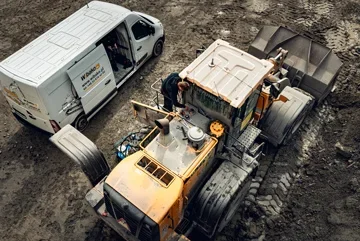
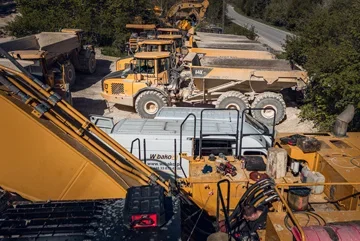
In the case of work carried out by our mobile service for agricultural and construction machinery, mechanics can perform dismounting directly at the customer's site. For the John Deere W540, we performed the dismounting using a crane provided by the client. Before starting the lifting, we prepared the unit for safe removal from the engine compartment.
Hoses, lines, and accessory components that could hinder unit removal were disconnected. We paid special attention to cooling system hoses, air intake, fuel system, and electrical installation. Each connection was properly secured so that it would not be damaged or contaminated during transport and further work.
Before lifting the engine, we also checked the mounts and connection points between the unit and the machine. The engine removal itself was performed in stages, controlling its position relative to the remaining combine components. This minimized the risk of damaging hoses, wiring harnesses, or accessory elements remaining in the machine.
After removing the engine, the unit was prepared for transport to our headquarters in Kojszówka. On-site, thorough verification could begin, the execution of which in field conditions would be significantly more limited.
Disassembly and Verification of the John Deere 6068HT080 Engine
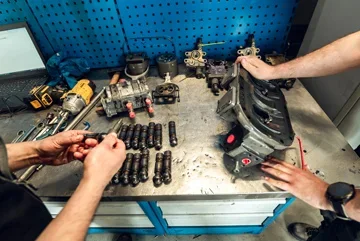
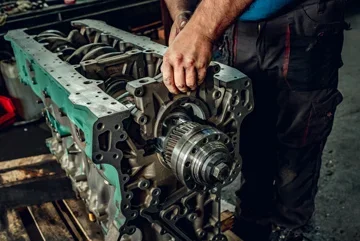
After delivering the engine to our workshop, we began its disassembly. In the case of a unit qualified for overhaul, we do not automatically replace all elements without checking their actual condition. The engine is disassembled, individual parts are thoroughly washed, and then mechanics perform their verification.
This approach makes it possible to separate components suitable for further use from those requiring repair, reconditioning, or replacement. This is particularly important for comprehensive engine overhauls, as the actual condition of components can often only be determined after dismantling the unit.
First, we inspected the basic engine components and the crank-piston system. The crankshaft was checked for signs of wear, overheating, and potential damage. We also measure journal dimensions, check crankshaft runout, and the cleanliness of oil galleries.
Connecting rods were also subjected to verification. Mechanics inspect them visually for cracks, signs of overheating, and wear. Twist, longitudinal bend, and bolt condition are checked. Checking elements cooperating with the crankshaft is also essential.
Another area was inspecting pistons, rings, and cylinder liners. Under natural engine wear, these elements may lose their original parameters. Cylinder surface and ring wear can lead to increased oil consumption, compression drop, and overall unit efficiency loss.
We also checked bearings and lubrication system components. Their condition can provide information about the conditions under which the engine previously operated. If metal shavings appear in the oil or filter, during disassembly we particularly carefully analyze elements that could be the source of contamination.
Verification and Reconditioning of the Engine Cylinder Head
An important stage in the John Deere 6068HT080 overhaul was also checking the cylinder head. We do not assume in advance that every cylinder head must be replaced. First, we assess its condition and check the possibility of further use.
The cylinder head is inspected for tightness and the condition of valve seats and guides. As part of the verification, we also check clearances and valve condition. Particularly important is the pressure/leak test, which detects potential cracks or leaks not visible during standard visual inspection.
The cylinder head pressure test is performed by submerging it in heated water and connecting compressed air. Observing any escaping air allows determining whether the cylinder head structure remains leak-tight.
Depending on the degree of wear, cylinder head reconditioning includes proper surface preparation, resurfacing (machining), replacement of valve guides and valves, and checking cooperating components. Thanks to this, after completing the work, the cylinder head is ready for reassembly on the restored unit.
Crank-Piston System Repair
The most key area of an overhaul for a high-mileage engine is often the crank-piston system. Its components work under significant mechanical and thermal load throughout their entire service life.
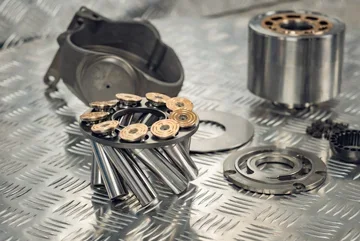
In the case of the John Deere 6068HT080, we conducted a thorough inspection of the crankshaft, connecting rods, pistons, rings, liners, and bearings. The shaft was measured to determine its degree of wear and decide whether it could be reused after proper machining.
Inspecting bearings, on the other hand, allows assessing the condition of surfaces cooperating with the shaft. Their wear can result from long-term engine operation, improper lubrication, or operating in harsh conditions. Components that do not meet required parameters are replaced.
Cylinder liners and pistons are also checked. In case of excessive wear of working surfaces, it is necessary to use appropriate new elements. New piston rings must cooperate properly with the cylinder surface to ensure proper combustion chamber sealing.
All components are properly prepared and cleaned before assembly. A professional engine overhaul does not consist merely of replacing a few parts. Proper preparation of all surfaces and maintaining the correct assembly order are crucial.
Engine Accessories Inspection
During the overhaul, we do not overlook engine accessories. Even a properly rebuilt engine will not work correctly if components cooperating with it are worn or faulty.
One of the inspected components is the turbocharger. We verify its axial and radial play. Such an inspection allows assessing the condition of rotating parts and deciding whether the turbocharger can be reused.
We also check other accessory elements, including the starter motor, alternator, and electromechanical components that affect proper engine starting and operation. If irregularities are detected, a decision is made to repair or replace the given component.
Accessory verification is particularly important before the dynamometer test. We want to ensure that during load testing, the engine can operate in conditions as close as possible to real-world operation.
Professional Assembly of the John Deere 6068HT080 Engine
After completing verification and necessary repairs, we began assembling the power unit. This stage requires high accuracy, as all previously checked components must be correctly connected into a complete engine.
Before mounting individual parts, we check their condition and the preparation of cooperating surfaces. During assembly, we pay attention to proper placement of crank-piston system components, mounting bearings, pistons, rings, and remaining components.
Equally important is proper preparation of the cylinder head and its connection to the engine block. After installing mechanical components, appropriate engine accessories are also installed. All operations are carried out with required assembly precision.
After assembling the engine, we do not proceed directly to installation in the combine. The unit is first prepared for starting and testing on the engine dynamometer. This is one of the most important steps in our process, as it allows verifying the overhaul results before placing the engine back in the machine.
Engine Test on the Engine Dynamometer
The engine dynamometer is one of the key elements of the engine overhaul process implemented at WIBAKO. Thanks to the ability to run the unit outside the machine, we can check its behavior under controlled conditions and under load. This is especially important for units intended for machines working seasonally and under heavy load, such as grain combines.
An engine after overhaul is not treated as ready just because it was assembled correctly. Checking its performance is necessary. On the dynamometer, we can observe unit behavior during startup, running at various speeds, and during gradual load increases.
In the case of overhauled engines, we start tests under light conditions. The unit runs for a minimum of 16 hours at a load level of approximately 20-30% of nominal value. This stage allows for controlled verification of the rebuilt engine's operation in its initial operating period.
During the test, we observe basic unit operating parameters. We check its behavior under load changes, operational stability, and response to increasing required power. We also monitor whether disturbing symptoms appear that could indicate a problem with any of the components.
If, after operating under light conditions, the engine maintains correct parameters, we move on to the next testing stage. The unit is repeatedly loaded to check its behavior under conditions much closer to real work. This allows us to evaluate engine response not only during smooth operation, but also when using a larger portion of its capacity is required.
Testing on the dynamometer has another very important advantage. It allows detecting potential problems before the engine goes back into the machine. If the unit were installed without prior testing, any irregularity would mean having to perform diagnostics again right on the combine. The dynamometer minimizes this risk and offers the opportunity to thoroughly evaluate the overhaul results.
Successfully passing dynamometer tests serves as confirmation for us that the engine can be prepared for the next stage. Only after completing the tests is the unit transported and prepared for installation in the John Deere W540.
Installation of the Overhauled Engine in the John Deere W540
After successfully completing tests, it was time to reinstall the engine in the combine harvester. Installing the power unit is a process just as important as its prior overhaul. Even a very well-prepared engine must be properly installed in the machine, and all connections must ensure safe and stable operation.
During installation, the engine was guided into the compartment using a crane provided by the client. Mechanics gradually positioned the unit relative to mounting points, while controlling distances from elements located in the engine compartment.
Next, we installed mounts and connections between the engine and the machine. We paid special attention to proper connection of the cooling system, air intake system, fuel system, and electrical installation.
During reinstallation, air intake piping is thoroughly checked. If we detect wear or damage to any piping components during disassembly, they should not be left uninspected. Air intake leaks can negatively affect engine performance, so connections are checked for proper attachment and tightness.
We proceed similarly with cooling system hoses. Their correct connection has a direct impact on the unit's operational safety. After completing installation, we check connections and inspect for leaks.
Preparing the machine for startup also includes replacing filters and performing initial checks. Before starting for the first time, we check key connections, fluid levels, and elements disconnected during disassembly.
After starting the engine, we observe its operation on-site. Response to rpm changes, operational stability, and tightness of all previously made connections are monitored. We do not end our work the moment the engine simply starts and runs.
An important element is also testing the machine with the operator. The operator can check combine behavior from a daily operation standpoint, while our mechanics monitor engine and accessory performance. Functional tests are conducted, and unit behavior is observed during load increases.
Successful completion of tests confirms proper engine operation in the machine. After checking unit performance, connections, and absence of unwanted leaks, an installation report is prepared.
Service Maintenance of the Engine After Overhaul
An engine overhaul does not end when the machine is handed over to the client. The first hours of rebuilt unit operation are particularly critical. For this reason, we recommend performing the first filter replacement after 50 operating hours (mth) from engine startup.
The 50 mth inspection is performed by our service team. Mechanics travel to the client and check not only the filters themselves, but also the overall condition of the engine and accessories. Connections made during installation, system tightness, and proper unit operation are checked.
Such an inspection also makes it possible to detect potential leaks or minor irregularities that might only appear after normal operation begins. Early response to such symptoms helps reduce the risk of more severe breakdowns.
We recommend subsequent inspections every 250 operating hours (mth), but no less frequently than once every 3 months. All engines offered by WIBAKO after overhaul are covered by a warranty, and our service team can also provide ongoing maintenance.
John Deere 6068HT080 - An Engine for Heavy-Duty Machinery
Engines from the John Deere 6068 family are used in various machines utilizing diesel engines for propulsion and powering working systems. In the case of agricultural machinery, their ability to work stably for long periods under heavy load is of particular importance.
The John Deere 6068HT080 unit can be found in machines where a combination of adequate power, durability, and the ability to work in harsh conditions is required. When identifying a specific engine version, it is always worth using the full engine designation and serial number, as the configuration may depend on the application and machine version.
WIBAKO specializes in service and overhauls of engines used in agricultural, construction, and other off-highway machinery. If a unit requires overhaul, we can perform diagnostics, dismounting, transport to our headquarters, comprehensive verification, repair, and dynamometer testing.
John Deere Engine Service and Machinery Maintenance
In case of engine failure, it is not always necessary to arrange transport for the entire machine yourself. Our mobile service can travel to the client and perform unit dismounting on-site. Depending on the situation, the engine can then be transported to Kojszówka, where we can perform complete diagnostics and overhaul.
This solution allows limiting the scope of work performed directly at the machine's location. We perform engine dismounting using a crane provided by the client, and then take over the unit for further workshop service.
In addition to John Deere engines, we also service diesel engines from other manufacturers used in off-highway machinery. The scope of work can include diagnostics, major overhaul, cylinder head verification, crank-piston system inspection, accessory repair, and engine dynamometer testing.
We serve clients from various regions of Poland. For projects involving the John Deere W540 and similar machines, dismounting and mounting can be carried out by our mobile service, including the Kraków area and other parts of Lesser Poland. After workshop repairs, the engine can be reinstalled at the client's location and subjected to functional tests.
Summary of the John Deere 6068HT080 Engine Overhaul
The overhaul of the John Deere 6068HT080 engine used in the John Deere W540 straw walker combine harvester was carried out as a comprehensive process including diagnostics, dismounting, component verification, repair, assembly, dynamometer testing, and reinstallation in the machine.
A key advantage of this approach is the ability to inspect the unit at every stage. First, we determine the cause of the problem in the machine, then thoroughly check the engine after dismantling. Among other components, we verify the crank-piston system, crankshaft, connecting rods, pistons, rings, liners, and bearings, as well as the cylinder head and accessories.
Upon repair completion, the engine undergoes a test on the dynamometer. This allows us to check the unit under load conditions before reinstallation in the combine. Only after successful test completion does the engine go back into the machine.
We approach installation with equal precision. We check mounts, hose connections, intake piping, cooling system, electrical installation, and tightness. After starting, functional tests are conducted with the operator, and upon successful completion of tests, an installation report is prepared.
For the owner of the John Deere W540, this primarily means being able to return the machine to work with a unit whose condition has been thoroughly verified. For machines used during the harvest season, this is particularly important, as a reliable engine is a key condition for maintaining operational continuity.
After the overhaul is complete, we do not forget about subsequent maintenance. After 50 operating hours (mth) from startup, we recommend a first inspection by our service team, including filter replacement and checking the overall condition of the engine, accessories, and connections. Subsequent inspections should be carried out every 250 mth, but no less than once every 3 months.
John Deere engine overhaul is not just replacing worn parts. It is a complete process aimed at restoring proper parameters to the unit and safely preparing it for further work. Combining mechanic expertise, thorough component verification, and dynamometer testing capabilities allows WIBAKO to comprehensively execute engine repairs for agricultural and off-highway machinery.
Related Materials
Contact Us
Do you need an overhaul for a John Deere 6068HT080 engine or service for a John Deere W540 combine harvester? WIBAKO performs comprehensive diagnostics, engine overhauls, dismounting and mounting, as well as unit testing on an engine dynamometer. Contact us to determine the scope of work.