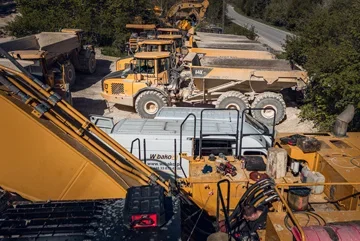


Volvo D7D Engine Overhaul in a Volvo EC240B Crawler Excavator
Volvo EC240B crawler excavators are among the most popular machines used in earthworks, road construction, infrastructure works, and bulk material loading. Equipped with a Volvo D7D engine producing approximately 134 kW, the EC240B model was designed for intensive operation under demanding working conditions. The Volvo D7D unit is valued for its smooth operation, high flexibility, and relatively low fuel consumption under heavy workloads.
The owner of a Volvo EC240B crawler excavator working on road investments near Katowice contacted our service center. The machine operator noticed a gradual power loss, increased engine oil consumption, and heavy smoking under load. Additionally, maintaining stable operating parameters for the power unit became difficult during operation. Due to the nature of the work performed and the need to maintain machine continuity, the client decided on a comprehensive overhaul of the Volvo D7D engine.
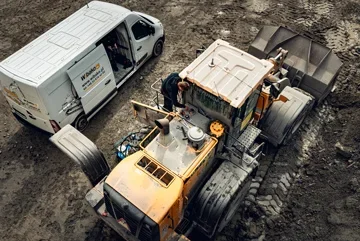
Our mobile construction machinery service team traveled to the customer to perform initial diagnostics. First, we measured the compression pressure, analyzed the unit's operating parameters, and inspected the intake and cooling systems. Next, we performed an endoscopic cylinder inspection, which revealed visible signs of cylinder liner wear and excessive carbon deposits on the pistons. Increased blow-by into the crankcase was also confirmed. The diagnostics indicated wear in the crank-piston system, which was the main cause of the loss in engine performance.
Disassembly of the Volvo D7D Engine from the Volvo EC240B Excavator
After confirming the need for an engine overhaul, we began the process of removing the power unit from the machine. The disassembly was carried out near Katowice using a crane provided by the customer. Our team of mechanics secured the workspace and prepared the excavator for safe engine removal.
We began the process by disconnecting the electrical system, fuel lines, hydraulic hoses, and cooling system components. Special attention was paid to securing the intake lines and the turbocharging system to prevent contaminants from entering the intake during transport. Next, the radiators, intercooler pipes, and auxiliary equipment restricting access to the engine mounts were removed.
The Volvo D7D engine was disconnected from the drivetrain and machine frame mounts in accordance with the manufacturer's service documentation. Once all lifting points were prepared, the unit was removed from the engine compartment using the crane. Each component was properly labeled and secured before transport to our headquarters in Kojszówka.
After loading, the engine was transported to our workshop, where we began a detailed inspection of all components. Thanks to our experience in servicing Volvo diesel engines and repairing construction machinery, we were able to quickly proceed to the next stages of work.
Inspection of the Volvo D7D Engine in the Workshop
Upon delivering the unit to the workshop, we performed a detailed teardown of the Volvo D7D engine. The inspection process began with checking the crankshaft rotation and examining the lubrication system. After removing the oil pan, metal shavings and signs of excessive bearing wear were found.
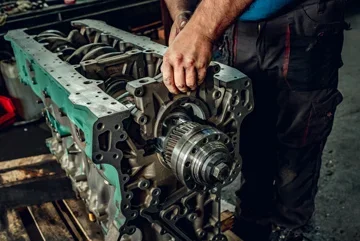
The next stage involved completely dismantling the engine down to the last nut and bolt. All components underwent industrial washing and a thorough visual inspection. The cylinder inspection confirmed excessive liner wear and visible signs of operation with limited lubrication. The pistons showed signs of overheating and worn piston rings, explaining the increased oil consumption and engine smoking.
As part of the crankshaft inspection, we measured the main and rod journals, checked the shaft runout, and inspected the oil galleries. The crankshaft required reconditioning via grinding to an oversize. Additionally, the connecting rods were inspected for twisting and bending. Some connecting rods required replacement due to exceeding the manufacturer's allowable tolerances.
The cylinder head of the Volvo D7D engine was subjected to a pressure test in a heated water bath. No cracks were found during the test; however, wear on the valve guides and valve seats qualified the head for a full rebuild. We also inspected the camshaft, whose lobes showed signs of wear.
The fuel system inspection included checking the injection pump and injectors. The components were sent to a specialized facility for injection system remanufacturing. Additionally, the turbocharger was checked for axial and radial play. Due to excessive wear on the rotating assembly, the turbocharger was remanufactured.
Rebuilding the Crank-Piston System
After completing the inspection process, we proceeded to rebuild the crank-piston system of the Volvo D7D engine. The crankshaft was ground and prepared for the installation of new main and rod bearings. All measurements were taken in accordance with the engine manufacturer's tolerances.
The engine block was checked for alignment and the integrity of the cooling passages. New cylinder liners, pistons, and a set of piston rings were then installed. During assembly, we paid close attention to the correct assembly clearance and the proper fit of all moving parts.
After inspection, the connecting rods were weight-matched and prepared for installation. Each component of the crank-piston system was thoroughly lubricated with assembly oil prior to installation in the engine block. This ensured proper conditions during the initial startup of the unit.
The oil pump and all engine seals were also replaced. The oil galleries were thoroughly cleaned of deposits and residue from previous engine component wear. In practice, the thoroughness of cleaning the lubrication system is of paramount importance for the subsequent durability of the engine after an overhaul.
Rebuilding the Volvo D7D Cylinder Head
Cylinder head reconditioning included resurfacing the mating surface, replacing valve guides, and installing new valves. The valve seats were machined according to the manufacturer's specifications. Additionally, we performed a leak test on the cooling passages and measured the valve spring height.
The camshaft underwent a detailed inspection regarding journal and lobe wear. Following a positive verification, the component was reinstalled along with new mating parts. The valve stem seals and a complete head gasket set were also replaced.
After completing the reconditioning, the head was prepared for mounting on the engine block. All cylinder head bolts were replaced with new ones according to the Volvo manufacturer's procedure. Strict adherence to tightening torques and the assembly sequence is critical for the unit's longevity after repair.
Fuel System and Auxiliary Equipment Repair
The Volvo D7D engine used in the Volvo EC240B excavator utilizes an advanced fuel supply system that ensures proper operation and combustion parameters. During the overhaul, we remanufactured the injectors and tested the injection pump on a test bench. This made it possible to restore the correct fuel dosing parameters.
After remanufacturing, the injectors were calibrated and checked for leaks and spray quality. Following its repair, the injection pump underwent performance tests and monitoring of operating parameters under load.
As part of the service work, we also remanufactured the turbocharger and inspected the alternator and starter motor. The condition of the electrical wiring and engine sensors responsible for monitoring temperature, oil pressure, and unit operating parameters was checked.
Great attention was also paid to the intake and cooling systems. Rubber hoses, clamps, and sealing components were replaced. The radiators were cleaned and pressure tested. These actions help reduce the risk of the engine overheating again during heavy machine operation.
Professional Assembly of the Volvo D7D Engine
The assembly process of the Volvo D7D engine was carried out in accordance with the manufacturer's procedures and service documentation. Before assembly, all components were re-verified for cleanliness and dimensional compliance. Mechanics performed the assembly using torque tools and specialized measuring instruments.
During engine assembly, we paid special attention to the correct timing alignment, the accuracy of fuel system installation, and the tightness of all connections. The lubrication system was pre-primed for the initial startup by filling the oil gallery and checking the pressure.
A new installation of fuel lines, breather lines, and intake system components was fitted. All connections were checked for leaks even before the initial engine startup. This minimized the risk of leaks occurring during dyno testing.
In the final stage of assembly, the remanufactured turbocharger, manifolds, water pump, and remaining engine accessories were installed. The unit was prepared for engine dynamometer testing, which represents one of the most critical stages of the overhaul process.
Testing the Volvo D7D Engine on an Engine Dynamometer
One of the key stages of every overhaul performed by WIBAKO is testing the engine on an engine dynamometer. Having our own dyno allows us to check the power unit before installing it in the machine, which significantly reduces the risk of issues occurring once the excavator is started at the customer's site.
After assembly was completed, the Volvo D7D engine was connected to a test stand equipped with an operating parameter monitoring system. During the first stage of the test, the unit ran for several hours under a load of approximately 20-30% of its nominal value. During this time, we monitored operating temperature, oil pressure, combustion parameters, and the integrity of all systems.
After successfully passing the break-in stage, the engine was subjected to multiple tests under full load. The engine dynamometer enables accurate replication of the operating conditions encountered during the operation of the Volvo EC240B excavator on a construction site. This allows us to check the engine's behavior during dynamic load changes and high torque demands.
During the trials, we also monitored fuel system parameters and combustion quality. The turbocharger response, exhaust gas temperature, and engine stability at various rotational speeds were verified. The dynamometer also allows for the detection of potential leaks, cooling system irregularities, or oil pressure problems.
In practice, dyno testing is extremely vital for engines used in construction machinery. Crawler excavators often operate under very heavy loads for many hours a day. Therefore, before mounting the unit in the machine, it is necessary to check it under conditions close to actual operation. As a result, the customer receives a proven engine ready for further work.
Upon completion of the tests, we performed an additional inspection of filters, oil parameters, and the tightness of all connections. Only after the successful completion of the entire process was the engine approved for installation in the Volvo EC240B excavator.
Installation of the Volvo D7D Engine in the Volvo EC240B Excavator
Following the dyno tests, the engine was transported to the customer near Katowice, where our mobile service team proceeded to install the unit into the machine. The installation process was carried out using a crane provided by the excavator's owner.
We began installation by preparing the engine compartment and thoroughly cleaning all mounting points. The condition of the engine mounts, hydraulic hoses, and the machine's electrical system was verified. The unit was then carefully lowered into the engine compartment and aligned according to the manufacturer's mounting points.
Once the engine was secured, we connected the cooling system, fuel lines, intake system, and exhaust system. Some rubber hoses and fastening elements showing signs of wear were replaced. The tightness of all intake system connections was checked very carefully, as even minor leaks can affect turbocharger operation and combustion parameters.
The next step involved bleeding the fuel system and filling all operating fluids. Prior to the first start, we checked electrical parameters, inspected sensor wiring, and verified the cooling system's functionality.
The initial engine startup took place in the presence of the machine operator. Our mechanics monitored oil pressure, operating temperature, and the engine's response to load changes. Once the unit reached operating temperature, a series of operational tests were performed, including hydraulic action, upper structure rotation, and boom movements.
After completing the operational tests and confirming the correct performance of the unit, an installation report was signed. The Volvo EC240B excavator was sent back to work on road investments.
Post-Overhaul Maintenance Service
All overhauled engines are covered by a warranty and the possibility of further maintenance service by WIBAKO. For the Volvo D7D engine, we recommended performing the first service check after 50 operating hours. During this inspection, our mechanics check filter conditions, connection integrity, and engine operating parameters.
Subsequent inspections are carried out approximately every 250 operating hours, but no less than once every three months. Regular maintenance service helps maintain the high durability of the power unit and reduces the risk of major breakdowns during machine operation.
Volvo D7D engines were used not only in Volvo EC240B crawler excavators but also in other construction machinery from the manufacturer. Thanks to our extensive experience in servicing Volvo engines, we perform repairs, remanufacturing, and comprehensive rebuilds of power units used in excavators, loaders, and other off-highway machines.
Summary of the Volvo D7D Engine Overhaul
The comprehensive overhaul of the Volvo D7D engine in the Volvo EC240B crawler excavator included full diagnostics, unit removal, crank-piston system rebuilding, cylinder head repair, fuel system remanufacturing, and engine dynamometer testing. Thanks to the work performed, the client regained a fully functional machine ready for further intensive operation.
WIBAKO provides comprehensive construction machinery service and Volvo diesel engine service. We perform engine disassembly and assembly directly at the customer's site, and all units undergo detailed load testing on an engine dynamometer after an overhaul.
If you are interested in a Volvo D7D engine overhaul, a Volvo EC240B crawler excavator repair, or professional construction machinery service, contact our team. We perform comprehensive diesel engine repairs and mobile machinery service throughout Poland.
Volvo engine service
Construction machinery engine overhauls
WIBAKO engine dynamometer
Crawler excavator service
Volvo D7D engine overhaul in a Volvo EC240B excavator
Do you need a Volvo D7D engine repair or Volvo EC240B crawler excavator service? WIBAKO performs comprehensive diesel engine overhauls, mobile disassembly and assembly, and testing on an engine dynamometer.