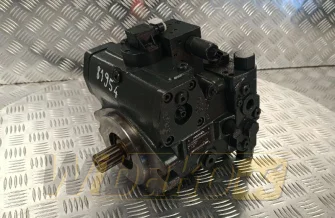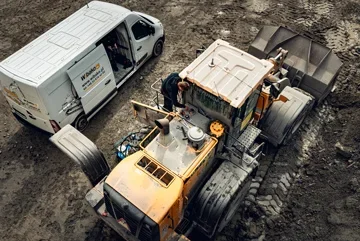



The Menzi Muck A91 is one of the most unusual excavators in the world – its walking legs let it work on steep slopes and in the mountains where a normal excavator stands no chance. The owner reported that the machine had clearly lost power and asked for a complete hydraulic check. So we removed the pumps – travel and working – together with the pump drive gearbox.
Removal: cab up, tank out
To reach the pumps, we first raised the cab with a special pump and then removed the hydraulic tank – after disconnecting the lines, the silencer and a cross-member, as space is very tight. The pumps and gearbox were removed separately to gain more room. Along the way we found that the silencer was cracked – we reported it to the customer, who decided to replace it with a new one himself.
Pump inspection
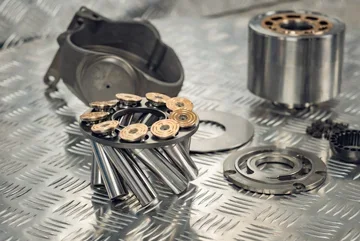
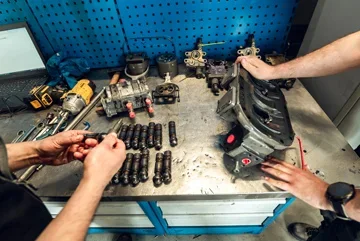
We always dismantle pumps in the same order: control pump and solenoids, plate, charge pump, rotating group, bearings, bearing shells, regulator, shaft seal and shaft.
- A4 pump (travel) – no serious damage, but the plate and gears of the charge pump were lightly scored and the swash plate showed typical wear under the bearings. Replaced: charge pump and bearings; everything else lapped.
- Second pump (working) – pistons in very good condition; the cylinder only needed grinding and lapping with the valve plate. New bearings, bearing shells and a full seal kit.
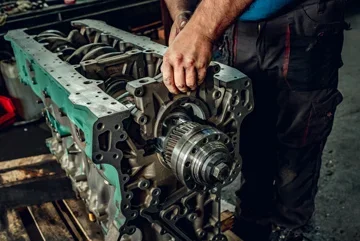
- Pump drive gearbox – bearings and gears fine, so an inspection, washing and new seals.
Assembly: details that determine durability
The gearbox gear, a very tight fit on its shaft, was warmed slightly so it would go on without pressing. The same with the bearing – but only because it has a steel cage; a bearing with a plastic cage must be pressed on. The freshly washed gearbox was given a little oil for the first start-up.
The trickiest moment on the A4 pump is seating the swash plate on its bearings. If a bearing does not sit properly against the edges, it will walk out of its seat as the plate tilts and the pump will be destroyed. The bearings are held in place with grease, aligned and locked with their retainer. The charge pump is fitted according to the direction of rotation (left-hand here) and on new studs. After assembly the set passed a dyno test.
An extra fault and installation
After removing the pump set we noticed the crankshaft seal behind the flywheel was weeping. The customer asked us to replace it, so we removed and refitted the flywheel before installing the pumps. Then the pump set went back in, followed by the tank (ports covered to keep dirt out), new filters, gearbox oil and coolant. A curiosity: on this machine part of the cross-member serves as the coolant expansion tank. After bleeding the system the machine passed its tests and went back to the customer.
Takeaways
- A loss of power is a signal to inspect the pumps before a serious failure – here new bearings, a new charge pump and lapping were enough.
- Removing the pumps is a good opportunity to check the crankshaft seal, the exhaust and other hard-to-reach areas.
- Fitting the swash plate bearings requires precision – the pump's service life depends on it.
See: hydraulic pump and motor repairs and construction machinery service.
Watch the repair video: The Customer Said: “It Has No Power”. We Stripped All the Hydraulics! | Menzi Muck A91