

Liebherr D936 A7 engine overhaul in a Liebherr L 586 wheel loader - comprehensive rebuilding of the power unit including engine dyno testing
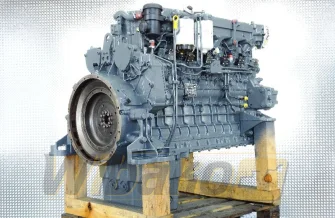
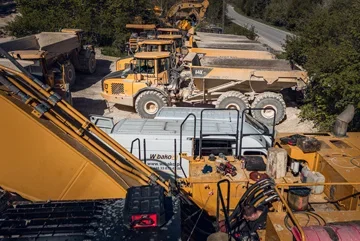
The Liebherr L 586 wheel loader is one of the largest machines used in aggregate quarries, recycling plants, transshipment yards, and bulk material transport companies. Due to its weight exceeding 30 tonnes and the large capacity of its working attachments, the machine is designed to work in very harsh conditions for many hours every day. A six-cylinder Liebherr D936 A7 diesel engine, with a displacement of approximately 10.5 liters, equipped with a modern Common Rail injection system and turbocharging with charge air cooling, is responsible for its high performance.
An owner of a Liebherr L 586 wheel loader operating near Kielce in the Świętokrzyskie Voivodeship contacted our WIBAKO service center. For a long time, the machine operators had observed increased engine oil consumption, a drop in power when working under load, and blue smoke coming from the exhaust system. The symptoms indicated wear on the crank-piston system, but a detailed diagnosis was necessary before making any decision on an overhaul.
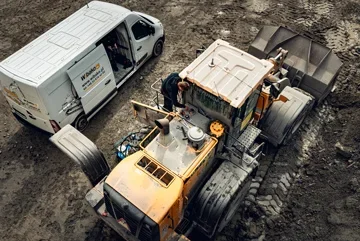
Diagnostics of the Liebherr D936 A7 engine directly in the machine
Our mobile construction machinery service team went to the customer and began diagnosing the power unit without requiring prior disassembly. The first stage was checking the engine's operational history and analyzing the problems reported by the operators. Then, we measured the compression pressure on individual cylinders and checked the engine's operating parameters.
The test performed showed reduced compression in several cylinders. To confirm the cause, we performed a cylinder leak test and inspected the interior of the cylinders using an endoscopic camera. The inspection revealed clear signs of wear on the cylinder liners and piston rings. Additionally, we checked the turbocharger for lateral and axial play and assessed the tightness of the intake system.
After completing the diagnostics, the Liebherr D936 A7 engine was qualified for a full overhaul. We agreed on a disassembly date with the customer and prepared a plan to transport the power unit to our headquarters in Kojszówka, where complex diesel engine rebuilding is performed.
Disassembly of the Liebherr D936 A7 engine from the Liebherr L 586 loader
The disassembly of the engine was performed by our mechanics directly at the machine's operating site. To remove the heavy power unit, we used a crane provided by the customer. Before starting the operation, we carefully secured all components interacting with the engine.
The cooling system hoses, fuel system, electrical wiring, intake system, and exhaust components were disconnected. All connections were marked to ensure correct assembly after the overhaul. We paid special attention to securing the hydraulic lines and components located in the loader's engine compartment.
After preparing the unit for removal, the engine was carefully lifted and transported to our base, where the process of thorough verification of all components began.
Engine verification in the workshop
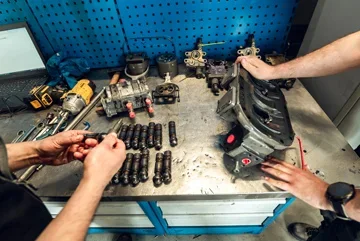
After delivering the Liebherr D936 A7 engine to the workshop, we began a complete disassembly of the unit. All parts underwent a cleaning process and a detailed dimensional inspection. The verification confirmed the earlier assumptions regarding the wear of the cylinder-piston components.
We performed a crankshaft inspection, including checking the journals, measuring runout, and evaluating the oil channels. The connecting rods were checked for straightness, potential cracks, and wear on working surfaces.
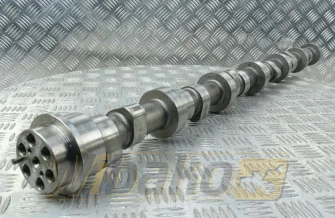
The engine cylinder head underwent a leak test in a heated water bath. We assessed the condition of the valve guides, valve seats, and other elements responsible for the proper operation of the valve timing mechanism.
Repair of the crank-piston system and regeneration of components
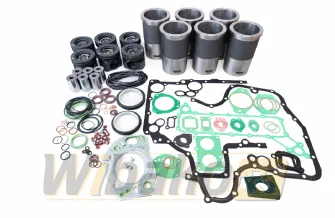
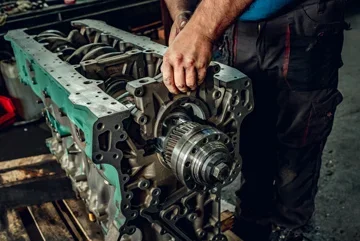
The largest scope of work involved the crank-piston system of the Liebherr D936 A7 engine. Worn cylinder liners were replaced with new components meeting the manufacturer's requirements. We also installed new pistons with a set of piston rings, and a set of new main and connecting rod bearings.
The crankshaft was regenerated by grinding the journals and re-checking all dimensions. After machining, the shaft was prepared for assembly in accordance with the manufacturer's technical documentation.
Cylinder head regeneration included surface planing, replacement of valve guides, installation of new valves, and checking the tightness of valve seats. This restored the correct sealing parameters of the combustion chamber.
We also checked the Common Rail injection system, the condition of the injectors, and the components responsible for delivering the correct dose of fuel. The inspection also covered the turbocharger, alternator, starter, and the engine's electrical accessories.
Professional engine assembly after overhaul
Assembly of the rebuilt Liebherr D936 A7 engine began with careful preparation of all components and checking the cleanliness of the oil and cooling channels. Each component was installed following the tightening torques specified by the manufacturer.
During the assembly of the unit, we used new seals, single-use bolts, and all necessary consumables. Special attention was paid to the correct adjustment of the timing mechanism, installation of the fuel system, and checking all connections of the lubrication system.
After completion of the assembly, we performed initial preparation of the engine for its first start-up and a leak check of all auxiliary systems.
Testing the Liebherr D936 A7 engine on an engine dynamometer
One of the most important stages of the entire process is the test on the engine dynamometer. WIBAKO belongs to a small group of companies dealing with construction machinery engine overhauls that possess their own dynamometer, allowing the power unit to be checked before its installation in the machine.
After the overhaul, the engine is first started and runs for a minimum of 16 operating hours at a load of about 20-30% of its nominal capacity. During this time, we control the operating temperature, oil pressure, fuel system parameters, and the tightness of all connections.
After the positive completion of the first running-in stage, the engine is repeatedly loaded up to working values. The dynamometer allows us to check the achieved power, the unit's response to load changes, the stability of operating parameters, and the correct operation of all accessories. Thanks to this, the customer receives a proven engine whose parameters have been confirmed before re-installation in the loader.
Installation of the engine in the Liebherr L 586 loader and machine start-up
Following the dyno testing, our mobile service delivered the engine to the customer and carried out the installation in the Liebherr L 586 loader. The operation was again performed using a crane provided by the customer.
The engine was seated in the engine compartment, and all fuel, electrical, cooling, and air intake lines were connected. We replaced filters, operating fluids, and conducted a thorough leak check of all connections.
The first start-up of the machine took place in the presence of the operator and our mechanics. We performed a series of operational tests checking the engine's behavior under load, the correct response of the hydraulic system, and the absence of leaks. After a positive completion of the tests, an assembly report was drawn up, and the machine returned to daily operation.
Maintenance service of the engine after overhaul
Every Liebherr D936 A7 engine overhauled by WIBAKO is covered by a warranty and the possibility of further servicing. We perform the first inspection after working approximately 50 operating hours from the moment the machine is started.
During such a visit, our mobile service replaces filters, controls the tightness of connections, checks the operating parameters of the unit and the condition of the accessories. We recommend performing subsequent inspections every 250 operating hours, but not less frequently than every three months.
Machines equipped with the Liebherr D936 A7 engine
The Liebherr D936 A7 engine is used not only in Liebherr L 586 wheel loaders. This unit is also found in other heavy machinery, such as the Liebherr L 566, Liebherr L 576, and Liebherr L 580 loaders, where it operates under demanding industrial conditions.
Service of Liebherr engines and construction machinery
WIBAKO performs a comprehensive service of Liebherr diesel engines, including diagnostics, disassembly and assembly at the customer's premises, transport of the unit to the workshop, full regeneration of components, and engine dynamometer testing. Thanks to this, we are able to verify the correctness of the repair before restarting the machine.
If you need a Liebherr D936 A7 engine overhaul, a Liebherr L 586 wheel loader repair, or service for other construction machinery, contact our team. We will prepare a scope of work tailored to the actual technical condition of the power unit.
Places for internal links:
Liebherr engine overhauls
Liebherr wheel loader service center
WIBAKO engine dynamometer
Contact us
Do you need a Liebherr D936 A7 engine overhaul or service for a Liebherr L 586 wheel loader? Contact us - we perform comprehensive diesel engine repairs, disassembly and assembly at the customer's location, and professional engine dynamometer testing.