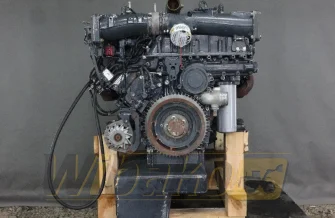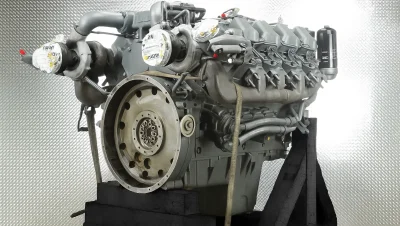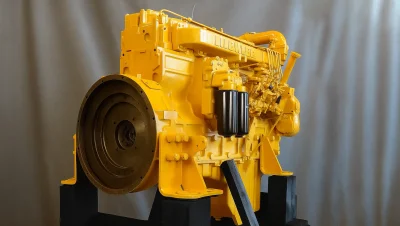


Volvo D12E Engine Overhaul in a Volvo A35E Articulated Hauler
The Volvo A35E articulated hauler is a machine designed for intensive work in demanding conditions, where the reliability of the powertrain has a direct impact on the efficiency of the entire operation. In this type of application, the engine operates for many hours under high loads, which makes its technical condition crucial for the proper operation of the machine. In the case described here, a comprehensive overhaul of the Volvo D12E engine was required.
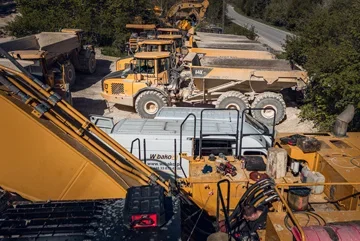
The Volvo A35E belongs to the group of articulated haulers used for earthworks, road construction, site preparation and material transportation. Its articulated design allows the machine to maintain good manoeuvrability even on uneven and demanding terrain. At the same time, the working conditions of an articulated hauler result in significant loads being transferred to the engine, drivetrain and other components.
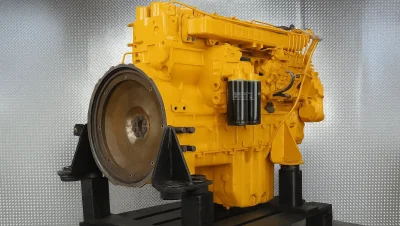
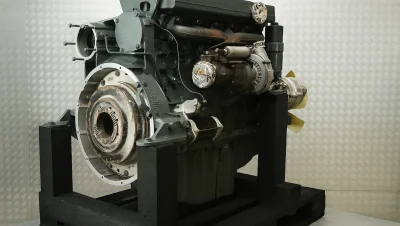
The Volvo D12E is a diesel engine used in heavy-duty machines and working vehicles. When overhauling an engine of this class, replacing only one damaged component is not enough. A thorough inspection of the entire engine is necessary because wear of one component can affect other parts of the crankshaft-piston system, cylinder head, lubrication system or auxiliary equipment.
In this case, the reason for sending the engine for overhaul was wear of the crankshaft and connecting rod bearings. Symptoms of this type of problem may include unusual engine noises, reduced oil pressure and the presence of metallic contaminants in the lubrication system. Therefore, before starting the removal process, we carried out diagnostics to determine the condition of the engine and confirm the direction of further work.
Initial diagnostics of the Volvo D12E engine in the Volvo A35E
The first stage was to diagnose the engine while it was still installed in the Volvo A35E articulated hauler. The purpose was not only to confirm the reported symptoms, but also to collect information necessary to plan the next stages of the repair. With an engine suspected of having worn crankshaft and connecting rod bearings, particular importance is placed on checking the lubrication system and observing the behaviour of the engine during operation.
First, we checked the basic engine operating parameters and paid attention to characteristic noises coming from the lower part of the engine. The level and condition of the engine oil were also inspected. Oil pressure was an important part of the diagnostic process, as an incorrect value may indicate wear of components in the lubrication system, including the bearings.
The next step was to inspect the oil filter and analyse any contaminants found inside it. The presence of metallic particles is a warning sign that cannot be ignored. Combined with unusual operating noises and irregularities in oil pressure, it indicates the need for a detailed mechanical inspection.
The diagnostics carried out on the machine showed that continuing to operate the engine without an overhaul would be risky. In such a situation, simply eliminating the symptom does not provide assurance of a durable repair. The engine therefore had to be removed and subjected to a complete workshop inspection.
Removal of the Volvo D12E engine from the articulated hauler
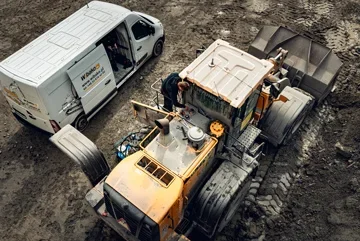
The engine was removed from the Volvo A35E by our mechanics using a crane provided by the customer. Proper preparation of the machine is extremely important during this type of work. The engine is connected to numerous systems of the hauler, so all installations must be carefully disconnected and the components remaining in the machine properly protected before the engine can be removed.
The work began by preparing the working area and securing the machine against accidental starting. We then proceeded to disconnect the installations and components connected to the engine. Electrical connections, cooling system connections, fuel lines and components associated with the intake and exhaust systems were disconnected.
Particular attention was paid to the cooling system. Hose connections were secured in a way that prevented unnecessary damage to components remaining in the machine during removal. The same approach was used for the intake system. The air piping had to be properly protected because its future tightness would have a direct influence on the operation of the turbocharged engine.
After disconnecting the auxiliary equipment and mounting components, the engine was prepared for removal. During lifting, we used the crane provided by the customer and took particular care not to damage either the engine or components located inside the engine compartment. Once removed, the Volvo D12E was prepared for transportation to our headquarters in Kojszówka, where the detailed workshop inspection began.
Workshop inspection of the Volvo D12E engine
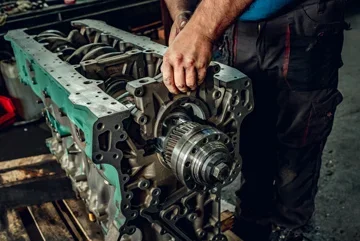
After the engine was delivered to our headquarters in Kojszówka, we began dismantling it. Inspecting an engine intended for overhaul does not mean automatically replacing every component. Each part is assessed to determine whether it can continue to be used, requires reconditioning or must be replaced. This allows the scope of work to be adapted to the actual technical condition of the engine.
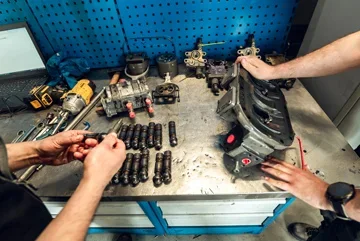
The engine was dismantled into individual assemblies, and the removed components were cleaned and prepared for measurement on an ongoing basis. Particular attention was paid to the lower section of the engine, as this was where the components associated with the main cause of the overhaul were located.
The bearings and connecting rods were inspected to determine their degree of wear. The crankshaft journals, oil passages and other components affecting proper lubrication were also checked. The crankshaft was visually inspected, its journals were measured and we checked for signs of overheating, wear or damage.
The crankshaft inspection also included checking its runout. It was important to determine whether the crankshaft could be reused after suitable machining or whether replacement would be necessary. The oil passages were also checked, as their cleanliness and unobstructed condition are essential for proper bearing lubrication.
The connecting rods were inspected as well. The inspection included a visual assessment for cracks, signs of overheating and wear, as well as measurements related to their geometry. The connecting rod bolts were also checked. All of these operations are important because the proper cooperation of the crankshaft, connecting rods, bearings and pistons is fundamental to correct operation of the crankshaft-piston system.
Crankshaft-piston system of the Volvo D12E
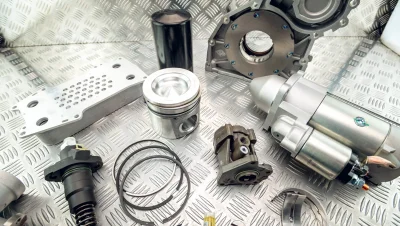
The most important area of the overhaul was the crankshaft-piston system. This was where the components associated with the wear that had led to the repair were located. After dismantling the engine, we were able to carefully assess the condition of the crankshaft, connecting rods, pistons, piston rings, cylinder liners and bearings.
The crankshaft was thoroughly cleaned and subjected to measurements. We checked journal diameters, surface condition and crankshaft runout. With components of this type, even small deviations can be significant, which is why measurements are performed before deciding whether a component should be machined or reused.
The connecting rods were also inspected. We assessed their visual condition, geometry and any signs of overheating. The areas cooperating with the bearings were also checked. Bearing wear should never be analysed separately from the condition of the crankshaft and connecting rods, as these components work together during every engine cycle.
The inspection also covered the pistons, piston rings and cylinder liners. We checked the working surfaces, signs of wear and the condition of components responsible for proper sealing of the combustion chambers. This helps prevent a situation where only the bearings are replaced and the engine is reassembled even though other components of the crankshaft-piston system also require attention.
After completing the measurements, we determined the necessary scope of work. Worn components were designated for replacement or appropriate reconditioning, while parts that met the required technical specifications could be reused after thorough preparation.
Inspection and reconditioning of the engine cylinder head
The Volvo D12E overhaul also included a detailed inspection of the cylinder head. Even if the main cause of the problem is located in the lower part of the engine, the cylinder head cannot be overlooked during a comprehensive overhaul. Its condition affects cylinder sealing, correct valve operation and the overall efficiency of the engine.
The cylinder head was cleaned and subjected to a detailed inspection. We checked the valve seats, clearances and sealing. The sealing test involves appropriate preparation of the cylinder head, immersing it in heated water and applying compressed air. Observation makes it possible to identify areas where escaping air may indicate leakage or cracking.
Depending on the degree of wear, cylinder head reconditioning includes machining as well as replacement of valve guides and valves. The aim is to prepare the cylinder head for further operation while maintaining the required geometry and sealing. After the work is completed, the component is inspected again.
Fuel system and engine auxiliary equipment
During the Volvo D12E overhaul, we also inspected the fuel system components and engine auxiliary equipment. A comprehensive repair cannot be limited to mechanical components alone because incorrect operation of auxiliary equipment can affect engine performance after the overhaul.
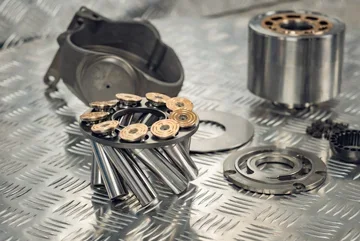
As part of the inspection, the condition of the fuel system components was assessed, and the injection pump can be tested on a test bench. This type of inspection allows its operation to be checked outside the engine and provides information necessary for an accurate assessment of the fuel system.
The turbocharger was also inspected. The inspection includes, among other things, checking axial and radial play. The turbocharger is an important component of the intake system, so its condition should be verified before the overhauled engine is started again.
Electrical and electromechanical components, including the starter motor and alternator, are also inspected. The aim is to reduce the risk of problems occurring after the engine has been installed in the machine.
Professional assembly of the Volvo D12E engine
After completing all repair work, we began assembling the engine. Assembly of an overhauled engine requires the correct sequence of operations, cleanliness and inspection of every connection. It is not enough simply to install new parts. Each component must be properly prepared and installed in accordance with the applicable technical requirements.
During assembly, we pay close attention to the preparation of mating surfaces. Components of the crankshaft-piston system are installed after their dimensions have been checked. Correct positioning of individual assemblies and compliance with the required assembly parameters are also essential.
Once the main assemblies have been installed, the remaining components, including the cylinder head and auxiliary equipment, are fitted. All connections are checked before the engine is started. Particular attention is paid to oil lines, fuel lines, cooling system connections and the intake system.
An important stage is preparing the engine for subsequent operation in the machine. Before installing the unit in the Volvo A35E, we check the completeness of the auxiliary equipment and the condition of components that will cooperate with the machine's systems. If wear of air piping or other components was identified during the earlier removal process, their condition is inspected again because the tightness of the intake and cooling systems has a direct influence on correct engine operation.
Volvo D12E engine test on the engine dynamometer
One of the most important stages of our work is the engine dynamometer test. The ability to test the engine outside the machine allows us to verify its behaviour under controlled conditions before it is installed in the Volvo A35E. This reduces the risk of a situation in which an engine is installed in the machine and only then develops a problem requiring it to be removed again.
After the overhaul is completed, the Volvo D12E is prepared for starting on the test stand. The engine operates under controlled conditions while our mechanics monitor its basic operating parameters. During the test, we pay attention to the stability of engine operation, temperature, oil pressure and engine behaviour as the load changes.
The test is not limited to briefly starting the engine. In the case of overhauled engines, the unit is operated for a minimum of 16 operating hours under light working conditions, with a load of approximately 20-30% of the rated load. This stage allows the newly overhauled components to begin operating gradually while their behaviour is monitored.
If the engine maintains its basic operating parameters after this period, the next stage of testing begins. The unit is repeatedly subjected to higher loads in order to check its behaviour under different operating conditions. Gradually increasing the load allows us to assess the engine's response and determine whether its operation remains stable under heavier workloads.
The dynamometer is also a controlled environment in which potential leaks, abnormal noises or problems related to auxiliary equipment can be observed more easily. Since the engine is outside the machine, access to its individual components is much better. Mechanics can respond to any irregularities without having to remove the engine from the machine again.
WIBAKO uses the engine dynamometer as an important part of the quality control process for overhauled engines. A loaded test provides considerably more information than simply starting an engine at idle. It allows us to check how the unit behaves when it actually has to perform work and deliver power to the drivetrain.
Only after the tests have been successfully completed and correct engine operation has been confirmed is the engine prepared for transportation and installation. This means that the customer receives a unit that has already been tested under controlled operating conditions.
Installation of the overhauled Volvo D12E in the Volvo A35E
After completing the dynamometer tests, the engine was prepared for reinstallation in the Volvo A35E articulated hauler. Installation is carried out using a crane provided by the customer. The process begins with positioning the unit safely and preparing it for placement inside the engine compartment.
The engine is lowered and positioned in the machine while maintaining the correct alignment with the mounting points. The engine mounts and remaining fastening components are then installed carefully. We check the correct position of the unit so that it does not create additional stress on hoses, wiring or other components.
The next stage is connecting the cooling system. The hoses are installed with the correct routing, and all connections are carefully checked for leaks. We also inspect clamps and connection points. Once the engine is started, the cooling system is monitored again because only during operation can the behaviour of all connections be fully assessed.
Particular attention is also paid to the intake system. The air piping must be tight and correctly connected. In a turbocharged engine, even a small leak in the intake system can affect engine performance. Therefore, all hoses and connections are carefully inspected before machine testing begins.
Fuel lines, electrical wiring and other auxiliary components are also connected. Filters are replaced according to the post-overhaul service procedure. Before the first start, we also check operating fluid levels and carry out basic inspections to prepare the machine for operation.
Once the Volvo A35E is started, we begin a series of tests. We do not limit ourselves to checking whether the engine simply runs. We observe its behaviour, monitor operating parameters and check the tightness of all previously installed connections. The machine operator participates in the tests, as their experience provides an additional opportunity to assess the behaviour of the articulated hauler under conditions similar to everyday operation.
Machine operating tests are carried out to check the engine's response to load and its cooperation with the other systems. We also monitor the machine for any oil, coolant or fuel leaks. Hose connections, mounting points and components that were disconnected during the removal process are checked again.
After the tests have been successfully completed and correct engine operation and the absence of unwanted leaks have been confirmed, an installation report is prepared. This means that the process does not end when the engine starts, but also includes practical verification of the entire assembly while operating in the machine.
Engine service after the overhaul
An engine overhaul is not the end of the process. Proper servicing after installation is important for the long-term durability of the unit. Therefore, after the overhaul and commissioning of the Volvo A35E, we recommend the first filter replacement after 50 operating hours.
The 50-hour inspection is carried out by our service team at the customer's site. It is not limited to replacing filters. Our mechanics inspect the general condition of the auxiliary equipment, verify correct engine operation and check the connections between the engine and the other machine components.
This is also the stage at which potential leaks that may have developed during the first hours of normal operation can be identified. Hoses, connections, mounting points and auxiliary equipment are inspected. Subsequent inspections should be performed every 250 operating hours, but no less frequently than every 3 months.
Machines in which the Volvo D12E engine is used
The Volvo D12E belongs to a family of diesel engines designed for heavy-duty applications. Engines from this family have been used in various machines and applications requiring a durable and efficient power unit. When looking for replacement parts or an engine, it is always important to verify the exact engine version, serial number and auxiliary equipment configuration.
In the case of the Volvo A35E, correct engine matching is particularly important. Individual configurations may differ in terms of equipment and the way the engine cooperates with the machine's systems. For this reason, accurate engine identification is one of the most important stages before beginning an overhaul or conversion.
Comprehensive Volvo diesel engine service
The overhaul of the Volvo D12E engine in the Volvo A35E articulated hauler demonstrates why a complete diagnosis should be performed when serious problems with the power unit occur instead of limiting the repair to replacing individual components. Wear of bearings and components cooperating with the crankshaft may be a sign of a problem that requires a detailed inspection of the entire crankshaft-piston system.
WIBAKO provides comprehensive Volvo diesel engine service, including diagnostics, engine removal and installation, engine overhauls and dynamometer testing. Our mobile service team can travel to the customer to carry out engine removal or installation. The engine can then be transported to our headquarters in Kojszówka, where workshop repairs are performed.
This solution combines the capabilities of a mobile service team with our workshop facilities. Our mechanics perform work on the machine on site, while the detailed engine rebuild is carried out in facilities equipped for this type of repair. An additional quality control stage is the possibility of testing the engine on our dynamometer before it is reinstalled in the machine.
Summary of the Volvo D12E overhaul in the Volvo A35E
The comprehensive overhaul of the Volvo D12E engine installed in the Volvo A35E articulated hauler included machine diagnostics, engine removal, transportation to our headquarters, disassembly and detailed inspection of the components, repair of the crankshaft-piston system, inspection of the cylinder head and auxiliary equipment, professional engine assembly and testing on the engine dynamometer.
After the tests were completed, the engine was reinstalled in the machine. We carefully checked all connections, the cooling system, intake system, fuel system and electrical components. We then carried out tests of the Volvo A35E together with the operator to confirm correct engine operation during machine operation.
Subsequent service is also an important part of the entire process. After 50 operating hours, our service team performs an inspection at the customer's site, including filter replacement and inspection of the general condition of the engine and its auxiliary equipment. This allows us to monitor the performance of the overhauled engine after it returns to everyday operation.
If you need a Volvo D12E engine overhaul, engine repair for a Volvo A35E articulated hauler, Volvo engine diagnostics or professional construction machinery service, WIBAKO can handle the complete process from removal, through overhaul and dynamometer testing, to engine installation in the machine.
Related materials and internal linking
Construction machinery service - information about the range of WIBAKO service solutions.
Volvo diesel engine service - diagnostics, overhauls and servicing of Volvo engines.
Volvo engine overhaul - comprehensive rebuilding of diesel engines.
Engine dynamometer - testing diesel engines before installation in the machine.
Do you need a Volvo D12E engine overhaul?
Do you need a Volvo D12E engine overhaul or service for a Volvo A35E articulated hauler? WIBAKO provides comprehensive diagnostics, engine overhauls, engine dynamometer testing, as well as engine removal and installation in construction machinery. Contact us to discuss the scope of work.