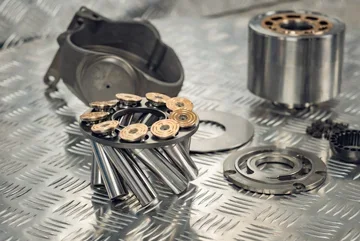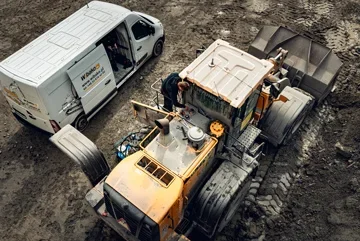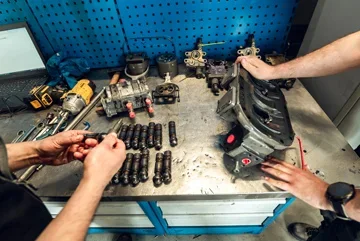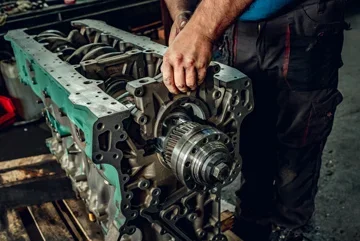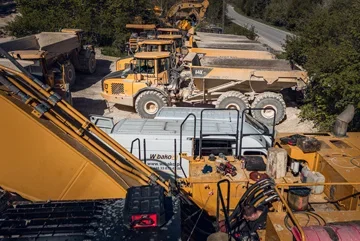


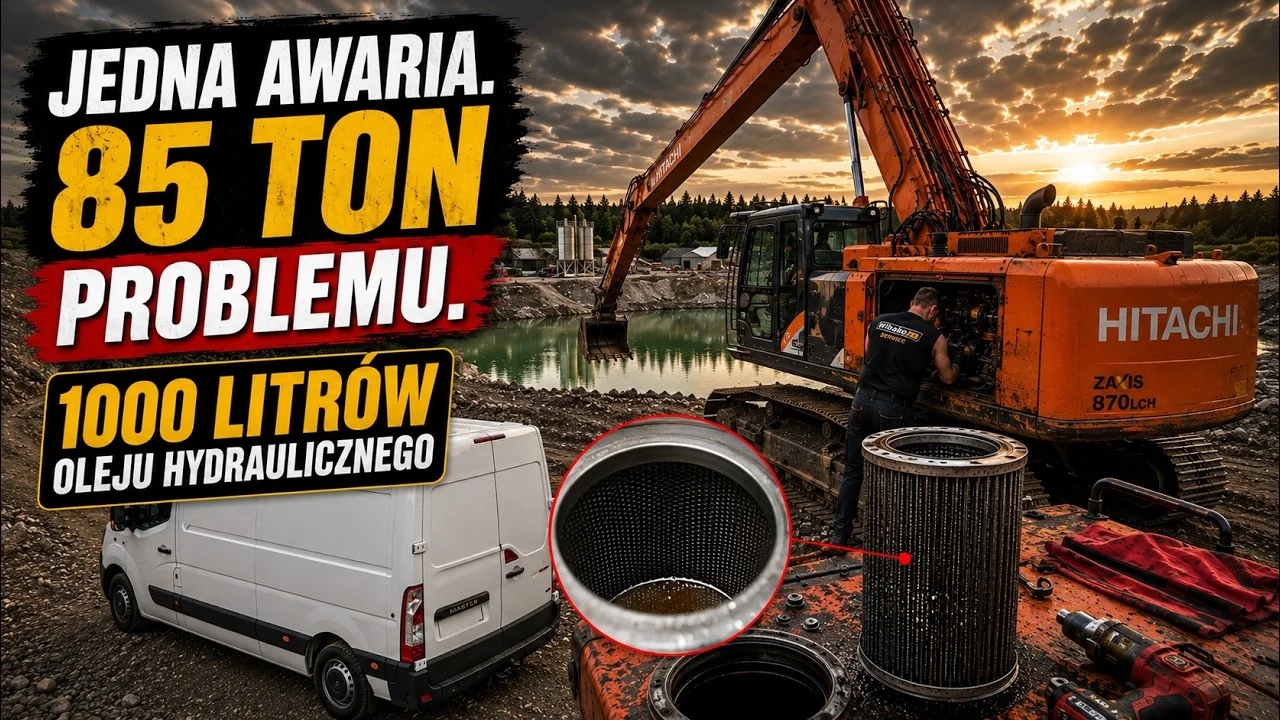
This time we headed to a gravel pit to a real colossus: a Hitachi ZX870 excavator (version 3, 2006, long reach) weighing about 84 tonnes with a 24-metre boom. The job looked simple: install three pumps rebuilt in our workshop, change the oil and filters and hand the machine back to the operator. However, one of the pumps had previously disintegrated – its rotating group was ground to pieces and the debris spread throughout the system.
Installing the pumps
The customer removed the pumps and we rebuilt them: one completely destroyed and two worn (main pumps and the slewing pump). On site we cleaned the mating surfaces, fitted new O-rings and set the pumps in place using the crane on our service truck. Then came the suction, pressure and pilot lines, the wiring harness, solenoids and sensors. A big advantage of such large machines: there is access everywhere, and you can practically walk between the engine and the control valve.
Tank and filters: debris even in the bypass
The tank had reportedly been cleaned by the local mechanics, but we always check. The bottom was glittering – there was plenty of debris, so we cleaned the tank again. The suction strainer was undamaged, so washing and blowing it out was enough. We replaced the return filters, the pilot filter and the main pump return filter.
A key detail: the main pump return filter has a bypass valve in its base that opens when the element is clogged. After a pump failure it is worth removing it and taking a look. Our hunch was right – under the valve were pieces of the retainer and metal particles. We cleaned the base and reassembled it.
Oil, bleeding and first start-up
The system holds over 1,000 litres of oil, and about 600 litres go into the tank alone. The customer supplied some new oil and three drums of lightly used oil – we filtered the latter and reused it, topping up with new oil. After bleeding the pumps (the large one bleeds together with the small one because they share a return line), it was time to start.
“One small thing”: a chafed wire
After start-up a whole list of sensor and pump control errors appeared – the machine jerked and the engine bogged down. Anyone who works on Hitachi machines knows that harnesses can chafe inside their conduits. After removing the covers we found a chafed wire touching its neighbour and causing a short. Once repaired, the error list was clear.
Measurements and filtration
Pump pressures P1 and P2 rise evenly and smoothly, e.g. approx. 320 bar on the bucket on one pump (each function has its own relief valve setting). As the system holds over 1,000 litres of oil, we left a filtration unit connected for about a week – the operator switches it on every morning and the machine is filtered while working. After a week we remove the unit and fit new filters.
Takeaways
- After a pump failure, check not only the tank and elements but also the filter bypass – debris can hide there.
- Lightly used oil can be filtered and reused.
- Pump control errors after installation do not always mean a hydraulic problem – on Hitachi machines check the harnesses right away.
- With large systems, filtering while the machine works saves time and does not extend downtime.
See: hydraulic pump and motor repairs, hydraulic oil filtration, construction machinery service.
Watch the repair video: One Small Thing Stopped an 85-Tonne Giant. How Did We Find It? Hitachi 870