

Why is the machine blowing blue smoke?
Do not ignore blue smoke. Early diagnosis can save you from a costly repair.
-
Phone
+48 33 870 42 00
Call us -
WhatsApp
+48 532 161 000
Message on WhatsApp -
E-mail
biuro@wibako.pl
Send an e-mail
Why is the machine blowing blue smoke? A guide for operators and machine owners
The distinctive coloration of exhaust fumes can quickly reveal what is happening inside the power unit. While white smoke indicates water vapor or coolant, and black suggests too rich a fuel mixture, the appearance of a blue cloud has a completely different, specific cause. Blue smoke from the exhaust is a clear, alarming message sent by the mechanical system. Ignoring this exhaust color in agricultural and construction machinery almost always results in a drastic drop in performance and costly engine seizure. The key to protecting the machine from serious failure is an immediate response and correctly locating the source of the problem.
What is blue engine smoke?
The appearance of blue or grey-blue exhaust fumes is a reliable sign of engine oil burning. In a properly functioning engine, oil serves solely a lubricating and cooling function and circulates in an isolated circuit. The combustion chamber should remain inaccessible to it.
When engine oil leaks into the cylinders as a result of leaks, mechanical wear, or faulty pressure, it begins to burn along with the diesel fuel. The result of this process is not only blue, thick smoke, but also a characteristic, unpleasant smell of burned lubricant and a noticeable, progressive decrease of oil on the control dipstick.
Most common causes of blue smoke
Oil can enter the combustion chambers in several ways. Here are the most common causes of this phenomenon:
1. Worn piston rings or valve stem seals
This is a classic mechanical fault resulting from natural operational wear or engine overheating. Damaged valve stem seals allow oil to flow from the cylinder head directly into the cylinders. On the other hand, worn piston rings (especially scraper rings) lose their ability to thoroughly wipe the oil film off the cylinder wall, causing the remaining oil to burn during every power stroke.
2. Damaged turbocharger seals
Modern machines operate under heavy loads, and their turbochargers are lubricated with engine oil under high pressure. When the rotor seals fail, oil begins to penetrate directly into the compressor housing. From there, it is rapidly sucked into the intake system and then goes straight into the combustion chambers, generating heavy, blue plumes of smoke.
3. Extremely clogged air filter and crankcase breathers (PCV)
This is a very specific case, often overlooked during the initial diagnosis. When the air filter is completely blocked with contaminants, a powerful vacuum is created in the intake system. The engine, unable to draw in air from the outside, literally begins to "suck" oil vapors from the crankcase through the ventilation system (breather). This oil is directed to the cylinders and burned there.
Quick symptom verification – Help table
The table below allows you to tentatively link the moment blue smoke appears with a specific component failure:
| When does the machine smoke? | Additional symptoms of the fault | Oil level status | Probable cause |
|---|---|---|---|
| Mainly just after startup, decreases after warming up | Smoking weakens at smooth operation | Gradual, slow loss | Worn valve stem seals |
| Constantly, intensifies significantly when accelerating | Drop in compression, loss of machine power | Continuous, clear oil loss | Worn piston rings or cylinder walls |
| Smokes heavily on a warm engine and under load | Oil visible in intercooler pipes | Rapid, sudden oil loss | Damaged turbocharger seals |
| Smokes evenly, immediate drop in power | Black coating and dust on the filter element | Loss linked to high RPMs | Extremely clogged air filter (high vacuum in the breather system) |
What to do when the engine blows blue smoke?
If you notice blue smoke, time is of the essence. Take the following protective steps:
- Check the oil level: Immediately check the engine oil level on flat ground. If it is too low, top it up to avoid engine seizure.
- Replace the filters: Check the air filter permeability and the condition of the crankcase breather.
- Inspect the intake: Disconnect the hose from the intercooler and check if there is liquid engine oil forced into it by a damaged turbo.
Remember! Ignoring oil burning carries a huge risk. In extreme cases, diesel engines can experience a phenomenon known as engine runaway – the unit then begins to uncontrollably burn its own oil instead of fuel, reaches maximum RPMs, and undergoes complete destruction.
Engine overhaul is a job for professionals – trust Wibako
Engine oil burning is rarely a fault that can be permanently fixed in field conditions using half-measures. Replacing piston rings, honing cylinders, or precise turbocharger regeneration require specialized measuring tools and vast technical knowledge. When a machine starts blowing blue smoke, a visit to a professional is necessary.
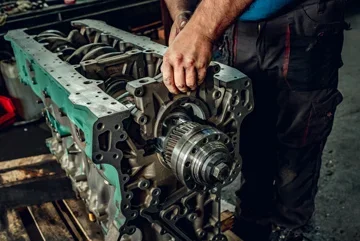
At Wibako, we offer top-class services in the field of diagnostics and major overhauls of industrial engines. We have an extensive technological infrastructure dedicated to servicing and repairing advanced engines from the world's leading manufacturers, such as Liebherr, Deutz, Perkins, Caterpillar, Cummins, and Kubota. Our team will precisely measure the degree of component wear, replace seals, and regenerate supercharging system elements, restoring the machine to factory efficiency and eliminating the problem of blue smoke. Entrust your equipment to Wibako engineers and gain peace of mind for trouble-free operation!