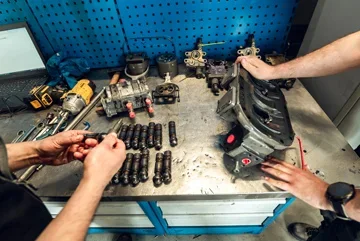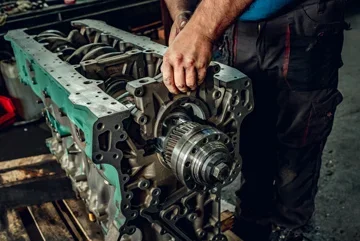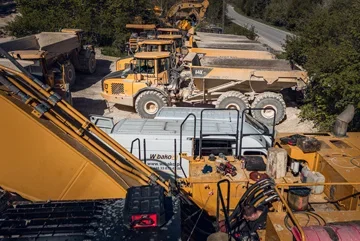


Overhaul and repair of internal combustion engines
Does your engine need repair? Contact us and restore it to full performance
-
Phone
+48 33 870 42 00
Call us -
WhatsApp
+48 532 161 000
Message on WhatsApp -
E-mail
biuro@wibako.pl
Send an e-mail
Liebherr LTM 1450-8.1 – Mobile Crane with Liebherr D9508 A7 Engine
The Liebherr LTM 1450-8.1 is a technologically advanced heavy-duty mobile crane designed for the most demanding lifting operations in construction, energy, and heavy industry. This model belongs to the renowned series of telescopic mobile cranes from the manufacturer Liebherr, highly valued for its high mobility, impressive lifting capacity, and reliability under heavy loads. A key role in the machine's operation is played by the Liebherr D9508 A7 engine with an output of approximately 505 kW, providing appropriate driving dynamics and stable operation of all working systems.
A maximum lifting capacity of 450 tonnes and a telescopic boom length of approximately 85 meters make the LTM 1450-8.1 one of the most efficient mobile cranes available on the market. The design was developed for fast movement between construction sites while maintaining high operating parameters.
Characteristics of the LTM 1450-8.1 Model
The Liebherr LTM 1450-8.1 is built on an eight-axle wheeled chassis, which enables efficient movement of the machine both on public roads and demanding construction sites. The use of active axle steering systems, hydropneumatic suspension, and modern operator assistance systems translates into high maneuverability despite the machine's substantial dimensions. The design of the telescopic boom allows for quick preparation of the crane for work, reducing the installation time of additional components.
Thanks to its multi-axle chassis and the possibility of mounting additional boom configurations, this mobile crane is used for:
Liebherr D9508 A7 Engine – Approx. 505 kW of Power
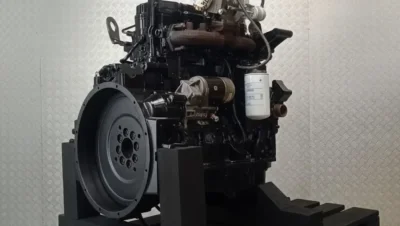
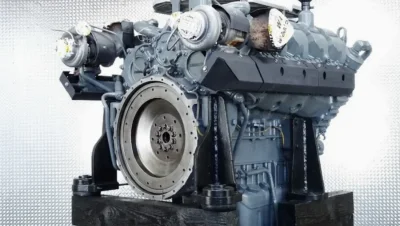
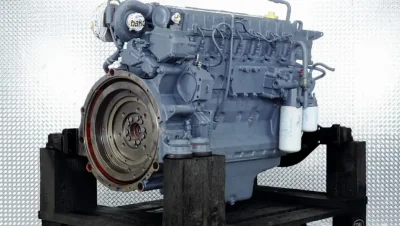
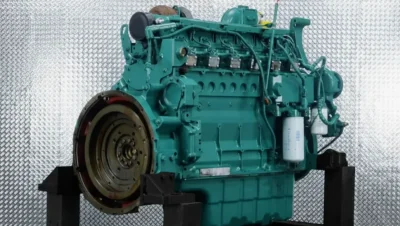
The Liebherr D9508 A7 power unit was designed specifically for applications requiring high reliability and a large torque reserve. The eight-cylinder diesel engine meets strict exhaust emission standards and provides the necessary power required to transport the heavy machine and power the hydraulic systems used during crane operation.
An output of approximately 505 kW at nominal speed and a torque exceeding 3,000 Nm enable efficient operation even during the most demanding lifting operations. These parameters enable efficient operation of the systems responsible for:
Key Parameters of the D9508 A7 Engine
Performance and Working Capabilities
The LTM 1450-8.1 is equipped with advanced Liebherr LICCON control systems, which enable precise lifting operations even at high working heights. The operator has extensive features for load monitoring, stability control, and boom configuration management, which increases safety and work efficiency.
The high-performance hydraulic system ensures smooth working movements and excellent control over the transported load. Thanks to the combination of high lifting capacity, a long telescopic boom, and modern operator assistance technologies, this model is perfectly suited for the execution of infrastructure, industrial, and energy projects of the highest complexity.
Technical Data of the Liebherr LTM 1450-8.1
Application of the Mobile Crane
The mobile design of the Liebherr LTM 1450-8.1 crane allows for quick relocation between construction sites without the need for specialized transport for most basic configurations. Thanks to this, the machine can efficiently perform tasks in various industrial sectors, ensuring high efficiency and reducing logistical costs.
The machine is most frequently used during:
Summary
The Liebherr LTM 1450-8.1 is a modern 450-tonne class mobile crane that combines very high lifting parameters with excellent road mobility. The efficient Liebherr D9508 A7 engine provides sufficient power for the most demanding crane operations and efficient machine transport. Thanks to advanced control systems, reliable construction, and high versatility, this model remains one of the most valued mobile cranes used in the construction and heavy industry sectors.