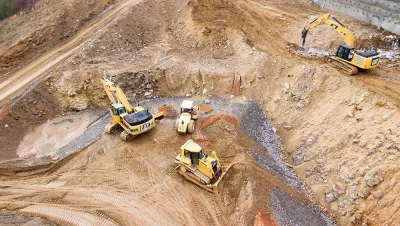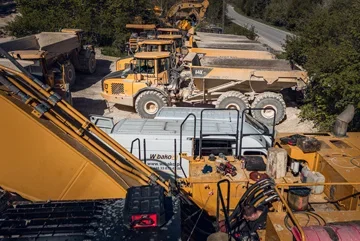


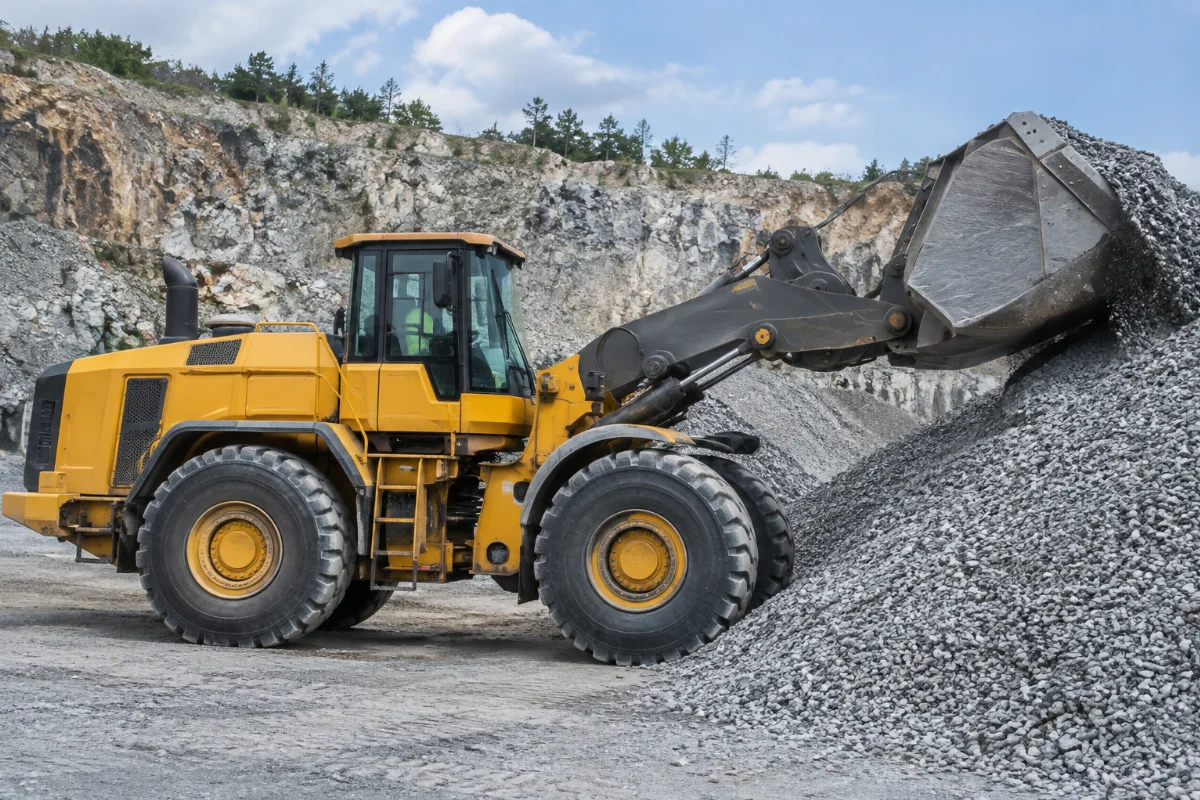
Construction loaders are among the most common machines on building sites, in gravel pits, quarries, stockyards and recycling plants. They are used to dig into, carry over short distances and load bulk materials as well as lump cargo. The name, however, covers several very different designs. Below we describe the types of loaders, their applications, how to choose the right machine, typical failures and what to look out for when buying a used loader.
Types of construction loaders
The basic classification depends on the undercarriage and the boom design. The figures below are approximate and vary by manufacturer and machine configuration.
- Compact wheel loaders – operating weight approx. 3–8 t, bucket approx. 0.5–1.5 m³. Municipal work, landscaping, small construction sites, farms.
- Medium wheel loaders – operating weight approx. 10–20 t, bucket approx. 2–4 m³. Aggregate loading, concrete plants, stockyards, earthworks.
- Large wheel loaders – operating weight over 20 t, bucket approx. 4–7 m³ (much more in mining). Aggregate quarries, loading haul trucks, stockpiles.
- Track loaders – operating weight approx. 10–40 t, bucket approx. 1–4 m³. Soft ground, demolition, quarries, work on slopes.
- Telescopic handlers (telehandlers) – lifting capacity approx. 2.5–6 t, lift height approx. 6–18 m. Building construction, agriculture, warehouses.
- Skid steer loaders (wheeled and tracked/compact track loaders) – rated operating capacity approx. 0.5–1.5 t. Confined spaces, work with a wide range of attachments.
- Backhoe loaders – operating weight approx. 7–10 t, front bucket approx. 1 m³ plus a rear backhoe arm. Utility networks, small excavations, municipal work.
Wheeled or tracked?
Wheel loaders perform best on level, firm ground. They are fast, can travel on public roads and move easily between jobs, which is what makes them so versatile. Track loaders offer better traction and lower ground pressure, so they excel in mud, on disturbed ground and in quarries. Their drawbacks are transport – every site change requires a low-loader – and higher undercarriage running costs.
Front loaders, swing loaders and side-tipping buckets
On a front loader the attachment works in a single plane – along the machine's axis, with the bucket moving up and down. This is by far the most common design. A swing loader has an upper structure that rotates relative to the undercarriage, so it can discharge material to the side without manoeuvring the whole machine. A side-tipping bucket is useful when loading along a wall or in narrow halls.
Articulated, telescopic and skid steer
Most modern wheel loaders are articulated loaders – the frame is split into front and rear sections connected by pins. Steering is done by articulating the frame with hydraulic cylinders, which gives a tight turning radius despite the machine's weight. A telescopic loader uses an extendable boom instead of conventional lift arms, increasing reach and lift height. A skid steer turns by varying the speed of the wheels on each side – it is highly manoeuvrable but causes heavy wear on tyres and the drivetrain.
The key parameter: tipping load
When selecting a loader, the critical figure is the tipping load – the load in the bucket at which the rear wheels lift off the ground. Rated operating capacity is usually taken as about half the tipping load at full articulation. For example: the compact Liebherr L504 Compact has a 0.7 m³ bucket and a tipping load of approx. 3,000 kg, the L508 – 1 m³ and approx. 3,900 kg, while the Volvo L30G with a 1 m³ bucket reaches approx. 5,500 kg. Bucket capacity must be matched to material density: the same machine needs a different bucket for sand than for wet rock.
Large wheel loaders
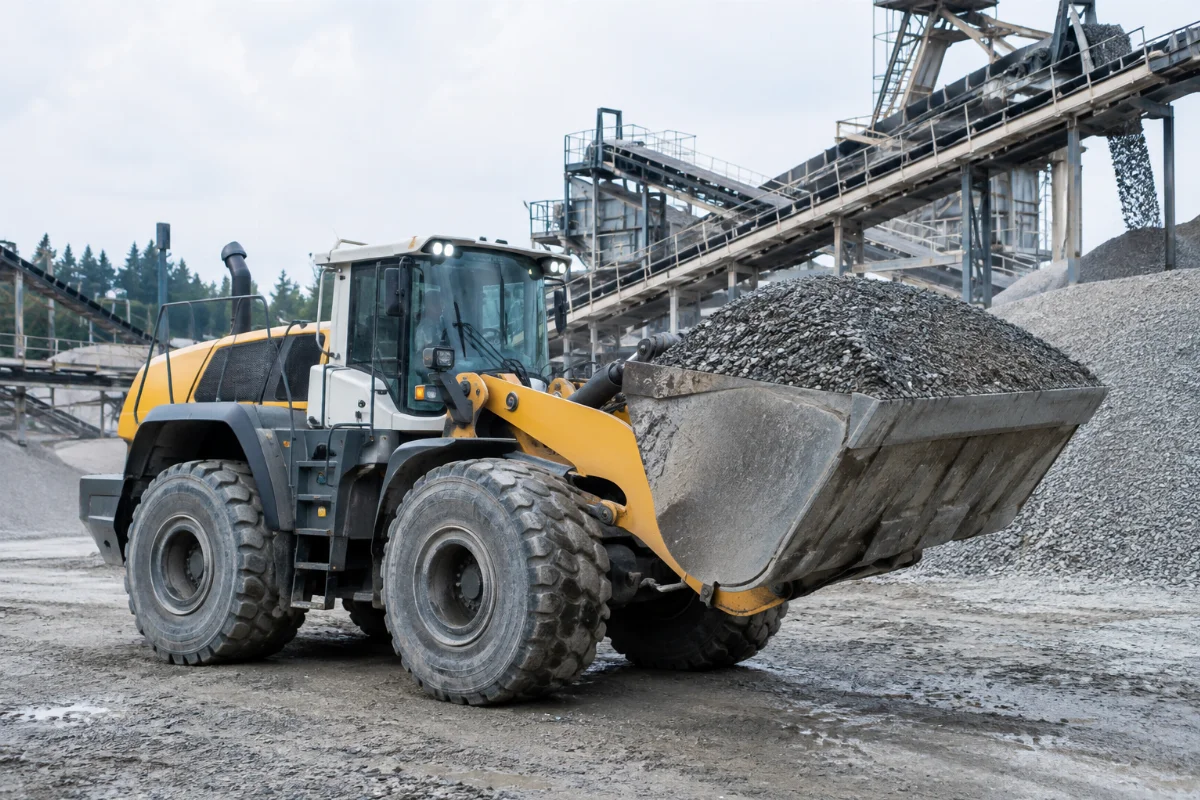
Large loaders work in continuous cycles, often on two shifts, so their reliability directly affects the output of the entire operation. This class is dominated by brands such as Liebherr, Volvo, Caterpillar and Komatsu.
- Liebherr L566, L580, L586 – the top of the Liebherr wheel loader range, with hydrostatic drive (power-split XPower in newer versions). The Liebherr L 566 is a popular machine for aggregates and recycling, the Liebherr L 580 handles heavy loading, and the Liebherr L 586 tops the series (tipping load approx. 22.5 t).
- Volvo L180 and L220 – classic loaders with torque converter transmissions, popular in quarries and stockyards. You can read about one of them in action in the article Performance and applications of the Volvo L180F wheel loader.
- Competing machines with similar specifications include the Caterpillar 988K XE, Volvo L350H and Komatsu WA600.
Loader attachments
A quick coupler allows attachments to be changed in minutes, so one machine can handle a variety of tasks. The most common are:
- buckets – general purpose, light material (high capacity), rock buckets with teeth, high-tip, grapple (clamshell) buckets,
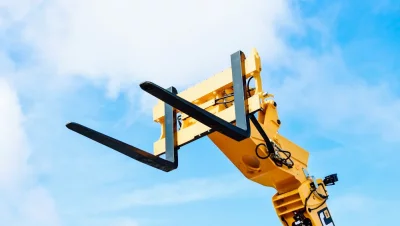
- pallet forks and grapples for timber, bales or scrap,
- snow ploughs and sweepers – road and yard maintenance,
- augers for drilling holes and cold planers for road surfaces – mainly on compact loaders.
With heavier attachments, remember that their weight reduces the permissible payload, and attachments requiring an auxiliary hydraulic circuit must be matched for flow and pressure.
Buying a used loader – what to check
- Articulation joint and pins – play in the frame articulation and in the lift arm and bucket pins. Excessive play means replacing bushings and often build-up welding and line boring of the bores.
- Frame and lift arms – cracks and signs of welding, especially around cylinder mounts.
- Transmission – smooth gear changes, jerking, slipping under load (driving into a pile), oil temperature after extended work, controller fault codes.
- Axles – leaks from hubs and final drives, noise when turning, brake performance, metal particles in the oil.
- Hydraulics – full-bucket lift time, drift of the lift arms and bucket (leaking cylinders or control valve), hose condition.
- Engine – cold start, smoke, crankcase blow-by, oil pressure, leaks.
- Documentation – operating hours, service history and ideally a diagnostic readout of the fault memory.
The most common loader failures
Transmission
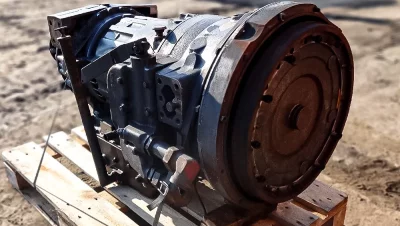
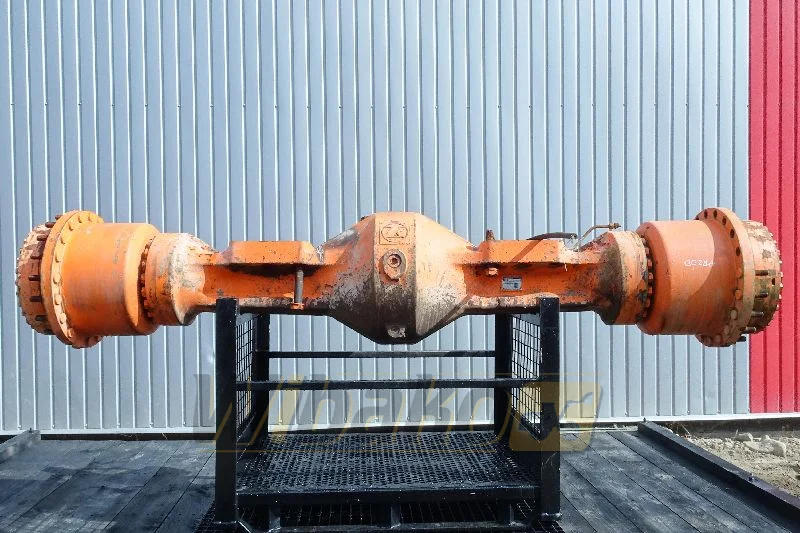
In loaders with powershift transmissions, typical problems include worn clutch packs, faulty control valves and solenoid valves, and oil overheating caused by a clogged cooler or worn torque converter. Symptoms are delayed engagement, jerking and loss of pushing power. In hydrostatic machines, problems concern the travel pump and motor. ZF transmissions are widely used, e.g. the ZF 3AVG-310 transmission, which can be rebuilt or replaced with a used, fully working unit.
Drive axles
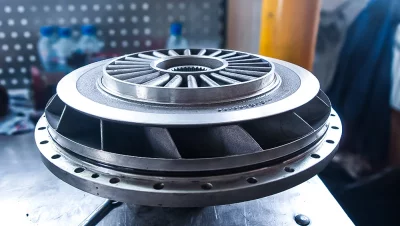
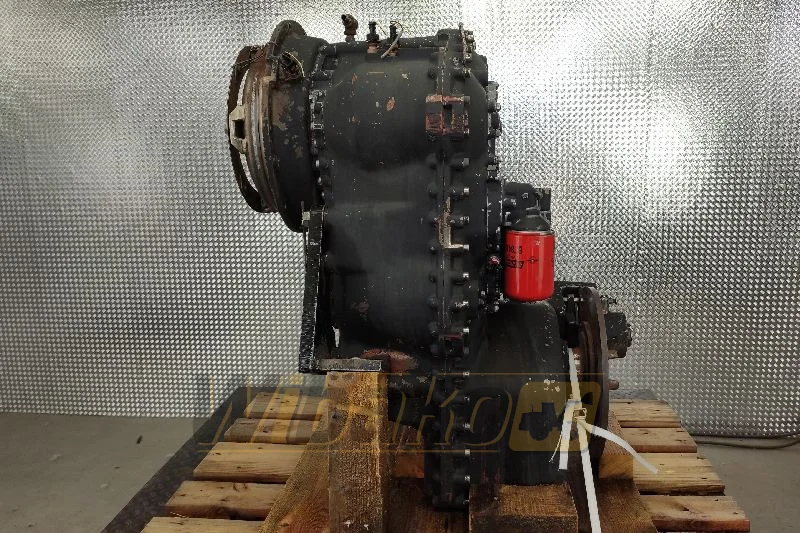
Loader axles carry high torque and shock loads. The components that wear most are differentials (especially limited-slip ones), planetary hub reductions, bearings and wet multi-disc brakes. Warning signs include whining while driving, knocking when turning, overheating hubs and metal particles on the magnetic drain plug. Many machines use ZF axles, e.g. the ZF AP-415/LK loader axle.
Working hydraulics
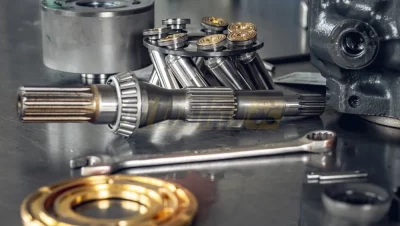
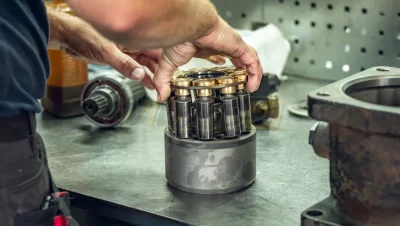
Reduced lifting force and slower movements are most often caused by a worn pump, leaking cylinders, misadjusted relief valves or contaminated oil. It is worth measuring pressures and flows before replacing components blindly.
Engine and cooling
Loaders often work in dusty conditions that clog radiators and air filters. The result is overheating, loss of power and, in extreme cases, cylinder head or piston damage. Regular cleaning of the cooling package and attention to filtration are the cheapest form of prevention.
Rebuild or replace?
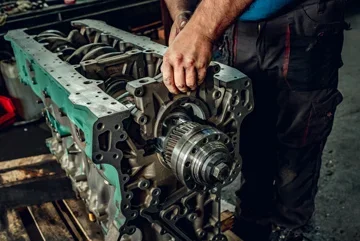
For transmissions, axles, pumps and diesel engines, an overhaul is usually cost-effective if the housings are undamaged and only the wear parts are worn. Replacing with a used or new unit makes sense when downtime is critical or the damage is extensive. The decision is best made after disassembly and measurement.
Loader parts and service at WIBAKO
Our shop offers new, used and remanufactured loader parts: engines and engine components, transmissions, axles, hydraulic components, cabs and radiators. We also provide construction machinery service and rebuild diesel engines, hydraulic pumps and hydraulic motors. If you are looking for a specific part or need to diagnose a fault, contact us – give us the machine model, serial number and symptoms, and we will help you find the right solution.