

Overhaul of the Liebherr D504T Engine in a Liebherr L 514 Wheel Loader
The Liebherr L 514 wheel loader began to noticeably lose its former performance. Reduced engine power, increasing oil consumption and deteriorating engine smoothness were clear signs that continued operation without detailed diagnostics could lead to more serious damage to the power unit. In such a situation, simply eliminating individual symptoms does not solve the underlying problem. The entire engine must be inspected to determine the actual degree of wear.
Our service received a Liebherr D504T engine operating in a Liebherr L 514 wheel loader. Machines of this type are designed for intensive work, often in dusty environments and under significant loads on the powertrain. The engine must therefore maintain adequate power, proper oil pressure and stable operating parameters for many hours of operation.
The Liebherr L 514 belongs to a group of wheel loaders designed for demanding applications where high machine availability is essential. In this type of work, a properly functioning engine has a direct impact on the productivity of the entire machine. Problems with the power unit can result not only in reduced performance, but also in increased fuel consumption, starting difficulties and the risk of further damage to engine components.
In this case, we decided to carry out detailed diagnostics followed by a comprehensive overhaul of the D504T engine. The scope of work was determined based on the actual condition of the components. This meant that we did not simply replace components at random, but rebuilt the engine based on measurements and inspections of individual parts.
Initial diagnostics of the D504T engine before removal
The first stage of the work was engine diagnostics while the unit was still installed in the machine. The reason for sending the engine for overhaul was primarily gradual operational wear. The symptoms had not appeared suddenly. With increasing operating hours, the operator noticed deteriorating engine performance, reduced power and increased oil consumption. Such symptoms may indicate wear of the components of the engine's crank and piston assembly, but other possible causes must first be ruled out.
We began the diagnostics with basic inspections. We checked the level and condition of the engine oil, as well as the intake and exhaust system components. We then assessed the engine's behavior during starting and operation. It was also important to determine whether there were any unusual noises, excessive vibrations or other symptoms indicating mechanical wear.
The next part of the diagnostic process involved checking operating parameters. Particular attention was paid to oil pressure and engine behavior under load. In the case of an engine showing increased wear, it is important to establish whether the problem is limited to the fuel system or accessories, or whether its source lies in the mechanical components inside the engine.
Depending on the available diagnostic options for a particular engine, a compression test may also be performed. This makes it possible to determine whether there are significant differences between the cylinders. An endoscopic camera can also be used to inspect the cylinder and piston surfaces without completely dismantling the engine.
The diagnostic results indicated progressive engine wear. We therefore decided to remove the engine and carry out a detailed workshop inspection. Only after dismantling the unit is it possible to accurately determine the actual condition of components such as the crankshaft, connecting rods, pistons, cylinder liners, piston rings and bearings.
Removal of the Liebherr D504T engine from the L 514
The engine was removed from the Liebherr L 514 wheel loader by our mechanics. The removal process was carried out using a crane provided by the customer. This solution allows the engine to be safely lifted out of the engine compartment while reducing the risk of damaging either the power unit or other machine components.
Before lifting the engine, it was necessary to disconnect all systems and components connecting the engine to the machine. Our mechanics removed the necessary hoses, electrical connections and accessory components. Particular attention was paid to the cooling system hoses and the lines responsible for supplying and routing intake air.
Engine removal involves much more than simply undoing the engine mounting bolts. Each connection must be properly secured and identified so that the subsequent installation can be carried out without unnecessary difficulties. Cooling system components are protected against contamination, as are the intake system components. This is particularly important for machines operating in dusty environments.
Once all necessary components had been disconnected, the engine was prepared for lifting. The unit was securely suspended using the crane and carefully removed from the engine compartment. After removal, the engine was transported to our headquarters in Kojszówka, where we began a detailed workshop inspection.
Workshop inspection of the D504T engine
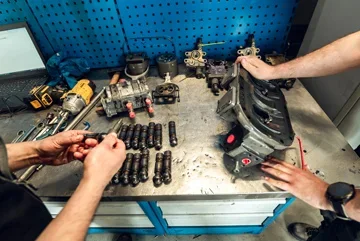
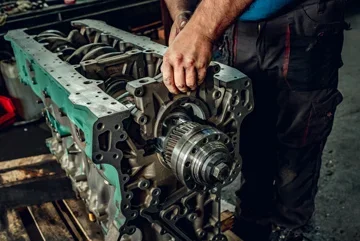
After the engine arrived at our workshop, we began dismantling it. In the case of an engine classified as requiring an overhaul, we do not assume in advance that every component needs to be replaced. Each part is removed, cleaned and then inspected by our mechanics.
The inspection process began with dismantling the unit into individual components. All parts were thoroughly washed because proper assessment of their technical condition is only possible after removing accumulated dirt and deposits. At this stage, we check for signs of overheating, wear, seizure, cracks and other mechanical damage.
The inspection confirmed the initial suspicions regarding operational wear. Particular attention was paid to the crank and piston assembly, as the condition of these components has a direct impact on compression, oil consumption and overall engine performance.
Crankshaft inspection
The crankshaft underwent a detailed visual inspection. Our mechanics checked the journal surfaces for signs of wear, overheating and potential damage. The journals were then measured and crankshaft runout was checked.
Another important part of the inspection was checking the oil passages. Their cleanliness and proper flow are essential for adequate lubrication of the bearings and other engine components. During an overhaul, it is not enough to inspect the crankshaft externally. Even relatively small dimensional deviations can affect the engine's operation after reassembly.
Connecting rod inspection
The connecting rods were inspected visually and dimensionally. Our mechanics checked them for cracks, signs of overheating and wear. The connecting rods were also checked for twisting and longitudinal bending. The connecting rod bolts were inspected as well.
This detailed inspection is important because connecting rods operate under very high loads. Any irregularities left inside an overhauled engine could lead to accelerated wear of other components during subsequent operation.
Inspection of pistons, piston rings and cylinder liners
Next, we inspected the pistons, piston rings and cylinder liners. Inspection of these components is particularly important in an engine that previously showed increased oil consumption and gradual loss of power.
We checked the working surfaces and signs of wear. The condition of the cylinder liners and the surfaces working together with the piston rings was also assessed. Depending on the measurement results, components may be classified for further use, regeneration or replacement.
Inspection of the engine cylinder head
The cylinder head was thoroughly cleaned and inspected. We checked the valve seats, guides and valves. One of the most important stages was the cylinder head leak test.
The leak test involves immersing the cylinder head in heated water and applying compressed air. By observing whether air escapes, it is possible to determine whether the cylinder head has leaks or cracks. Only after a positive result can a decision be made regarding further use of the component.
Inspection of the camshaft and accessories
The camshaft was also inspected. The inspection included a visual assessment and measurements of the main journals and cam lobes for wear. These components must maintain the correct parameters because their condition affects the proper operation of the entire engine.
The engine accessories were also inspected, including the turbocharger. In the case of the turbocharger, axial and radial play is checked. This makes it possible to assess its condition and determine whether it can be reused after the overhaul.
Overhaul of the D504T crank and piston assembly
After completing the inspection, we began the actual overhaul process. In the D504T engine, the main area of work was the crank and piston assembly. These components are responsible for converting the energy generated during combustion into mechanical movement, which is then transferred to the machine's powertrain.
As part of the overhaul, we inspected and appropriately prepared the crankshaft, connecting rods, pistons, piston rings, cylinder liners and bearings. The scope of replacement and regeneration was determined based on measurement results. This means that the overhaul is not simply a random replacement of parts, but a rebuild of the engine based on its actual technical condition.
If required by its condition, the crankshaft can undergo regeneration by grinding. After the work is completed, its dimensions are checked again. Maintaining the correct parameters of the surfaces working with the bearings is particularly important.
The condition of the bearings is equally important. Their condition is directly related to proper lubrication and maintaining the correct oil pressure. Worn bearings can lead to excessive clearances, which is why their condition is carefully assessed during the overhaul.
The pistons and piston rings were inspected for wear. In the case of an engine that has operated for many hours under demanding conditions, the cylinder liners cannot be overlooked either. Their condition affects the sealing of the combustion chamber, compression and oil consumption.
Regeneration of the Liebherr D504T cylinder head
The next stage of the overhaul was cylinder head regeneration. The scope of work was determined following the initial inspection. Cylinder head regeneration includes appropriate preparation of the surfaces, machining and replacement of worn valve guides and valves, according to the inspection results.
After the work has been completed, the cylinder head must maintain proper sealing. Therefore, after regeneration, we pay particular attention to the correct fit of the components and the condition of the valve seats. The aim is to prepare the cylinder head for reliable operation in the rebuilt engine.
Proper preparation of all mating surfaces is also important during assembly. This helps reduce the risk of leaks and ensures correct operation of the lubrication and cooling systems.
Fuel system and engine accessories
The fuel system is also inspected during the engine overhaul. Fuel injection components can have a significant impact on engine smoothness, power and fuel consumption. Depending on the engine design and available diagnostic options, individual components are appropriately tested.
If the inspection indicates that further testing of the injection pump is necessary, it can be tested on a test bench. Such testing makes it possible to assess its parameters outside the engine and determine whether the component can continue to be used or requires regeneration.
The condition of the accessories is equally important. We inspect the turbocharger, starter motor, alternator and electromechanical components. The turbocharger is checked for axial and radial play. This helps reduce the risk that, after installing the rebuilt engine, a problem will be caused by worn accessories that were left in place.
Professional assembly of the D504T engine
Once all regeneration work had been completed and the components classified for replacement had been replaced, we began assembling the engine. This is a stage that requires a high level of precision because a proper overhaul does not end with replacing components. Their correct preparation and installation are equally important.
The individual components of the crank and piston assembly were prepared for installation based on the results of the previous inspection. Our mechanics pay attention to the correct positioning of components, proper matching of mating surfaces and maintaining the required assembly parameters.
During assembly, the oil passages and sealing surfaces are also checked. This is done to ensure that after starting, the oil can reach all areas requiring lubrication and that the cooling system and other systems operate without leaks.
Once the main engine components have been assembled, the appropriate accessories are installed. Each component is checked before installation to reduce the risk of using a component with an uncertain technical condition. Particular attention is paid to the turbocharger and fuel system components.
After assembly, the engine is prepared for starting and testing. The engine is not sent directly back to the machine simply because it has been mechanically assembled. Before installation in the loader, it is important to verify its operation on an engine dynamometer.
Testing the Liebherr D504T engine on an engine dynamometer
The engine dynamometer is one of the important elements of our overhaul process. It allows the engine to be tested outside the machine, under controlled conditions and, most importantly, under load. This means that we can verify the D504T engine before it is installed again in the Liebherr L 514 wheel loader.
In the case of an overhauled engine, the first part of the test is performed under light operating conditions. The unit is started and operated for a minimum of 16 operating hours at approximately 20-30% of its nominal load. This period allows us to observe how the engine behaves after the rebuild and to check its basic operating parameters.
During the test, we monitor the engine under different operating conditions. We observe operating temperature, oil pressure, response to changes in load and overall engine smoothness. We also check for leaks and unusual noises.
After the initial testing period, if the engine maintains the correct parameters, we proceed to further tests. The unit is repeatedly subjected to higher loads to check its behavior during more demanding operation. This makes it possible to assess whether the rebuilt crank and piston assembly, cylinder head, fuel system and accessories are operating correctly.
Dynamometer testing also provides additional protection against installing a problematic engine in the machine. If irregularities appear during testing, we can address them while the engine is still in the workshop. When an engine is installed without prior testing, detecting a similar problem may require further diagnostics in the machine and, in some cases, another engine removal.
The dynamometer therefore allows us not only to confirm that the engine starts and runs, but above all to verify its behavior under load. This is particularly important for engines installed in wheel loaders, where the power unit may operate under significant load for a large part of its working time.
Only after the tests had been successfully completed was the D504T engine prepared for reinstallation in the Liebherr L 514.
Installation of the D504T engine in the Liebherr L 514 wheel loader
After completing the dynamometer tests, the engine was prepared for installation in the machine. Installation is just as important as the overhaul itself. Even a correctly rebuilt engine may not operate properly if hoses, connections or accessories are installed incorrectly.
The engine was placed into the loader's engine compartment using a crane provided by the customer. The unit was positioned correctly and the engine mounting process was then started. Proper alignment of the engine with the machine's components and correct connection of all previously disconnected systems were essential.
During installation, particular attention was paid to the cooling system. Hoses must be routed and secured correctly so that they do not rub against other components during machine operation. We also inspect the condition of the connections and check the system for leaks.
The intake system is treated in the same way. The air supply hoses must be installed correctly and remain airtight. A leak in the intake system can negatively affect engine operation, so all connections are carefully checked.
Electrical connections and the remaining components required to start the engine are also connected. Before the first start, an installation inspection is performed. We check fluid levels, filter condition, hose connections and areas where leaks could potentially develop.
After starting the engine, our mechanics monitor its operation. Engine parameters and the behavior of the individual systems are checked. We inspect the engine for oil, coolant or other fluid leaks. Hose connections and accessories are also inspected.
We then proceed to machine testing. The tests are carried out in the presence of the operator, as the operator knows the specific characteristics of the loader and can assess how the machine behaves while performing actual working functions.
During testing, we check the engine's response to changes in load and its behavior while operating the loader. It is important to confirm that the unit responds correctly to operator commands and maintains appropriate parameters during work. We also monitor machine operation after reaching normal operating temperature.
Successful completion of the tests means that the engine can be returned to normal operation. A protocol confirming the correct completion of the installation and testing process is also prepared.
Liebherr engine service and post-overhaul maintenance
An engine overhaul does not end when the machine is handed back to the customer. Proper maintenance after the rebuild is very important for the future service life of the unit. We therefore recommend carrying out the first inspection after 50 operating hours following the start-up of the rebuilt engine.
The 50-hour inspection is performed by our service team. Our mechanics can travel to the customer and carry out the inspection directly at the machine. This is not limited to changing filters. We also inspect the general condition of the accessories, connections between the engine and other machine systems, system tightness and correct engine operation.
After the first inspection, subsequent inspections are recommended every 250 operating hours, but no less frequently than every 3 months. Regular servicing makes it possible to detect leaks, loose connections or other irregularities that may develop during normal operation.
WIBAKO provides both engine overhauls and subsequent service support. If required, our mobile construction machinery service can also handle engine removal and installation. This means that the entire process can be carried out comprehensively, from machine diagnostics and engine overhaul to reinstallation, start-up and the 50-hour service inspection.
Machines equipped with the D504T engine
The D504T engine should primarily be considered in relation to the specific machine configuration and its intended application. In the overhaul described here, the engine was installed in a Liebherr L 514 wheel loader. When identifying an engine, it is always advisable to use its designation, serial number and the details of the specific machine.
This is particularly important when selecting spare parts. Even engines with the same designation may differ due to their configuration, application or production version. Before ordering parts, it is therefore worth contacting our technical department and providing the engine number and machine details.
Comprehensive Liebherr construction machinery service
The overhaul of the D504T engine installed in the Liebherr L 514 wheel loader demonstrates why a complete engine diagnosis is worthwhile when significant wear occurs, rather than simply eliminating individual symptoms. Reduced power and increased oil consumption were signs of a problem that required detailed inspection.
The entire process included machine diagnostics, engine removal, transport to our workshop, dismantling and cleaning of components, detailed inspection, overhaul of the crank and piston assembly, cylinder head regeneration, accessory inspection, professional assembly and testing on an engine dynamometer. After successfully completing the tests, the engine was reinstalled in the Liebherr L 514.
A major advantage of the entire process is the ability to test the rebuilt engine before installing it in the machine. The engine dynamometer allows us to load the unit and monitor its operation under controlled conditions. Only after successfully completing the tests is the engine returned to the machine.
Our services also include mobile service. If a machine requires engine repair or replacement, our mechanics can perform the necessary work at the customer's site. The removed engine is then transported to our headquarters in Kojszówka, where the overhaul and testing are carried out. Once the work is complete, we can return to the customer and reinstall the engine in the machine.
If you are looking for a company providing Liebherr construction machinery service, diesel engine overhauls and comprehensive power unit support, it is worth considering the entire repair process rather than simply replacing individual components.
In the event of similar problems with a wheel loader or another machine, it is useful to provide the engine designation and machine model. This allows us to determine the possible scope of diagnostics and select an appropriate solution more quickly.
Construction machinery service - link to the main service page.
Diesel engine overhauls - link to the page dedicated to engine overhauls.
Mobile construction machinery service - link to the mobile service page.
Liebherr machinery parts - link to the Liebherr parts category.
Summary of the Liebherr D504T engine overhaul
The D504T engine installed in the Liebherr L 514 wheel loader was comprehensively overhauled based on its actual technical condition. The process began with diagnostics and confirmation of symptoms associated with operational wear. The engine was then removed, transported to our workshop and thoroughly inspected.
During the overhaul, particular attention was paid to the crank and piston assembly, cylinder head and accessories. After the work was completed, the unit was professionally assembled and tested on an engine dynamometer. Only after successfully completing the tests was the engine reinstalled in the machine.
Following installation, we carried out detailed tests of the loader together with the operator. We checked engine operation, connection tightness and machine behavior under working conditions. As a result, the customer received not only a rebuilt engine, but a fully tested power unit ready for further operation.
After starting the rebuilt engine, we recommend carrying out the first inspection after 50 operating hours. Our service team can perform this inspection directly at the customer's site, checking not only filters and fluids, but also connections, accessories, system tightness and correct engine operation.
Contact us
Do you need a Liebherr D504T engine overhaul or service for a Liebherr L 514 wheel loader? Contact us - we provide comprehensive engine repairs, removal and installation services, and engine dynamometer testing.