The hydraulic travel motor and the swing motor are the hardest-working components on a crawler excavator. They carry full system pressure, operate in dust and mud and are coupled to planetary gearboxes. As they wear, the symptoms often resemble a fault in the pump, the control valve or the final drive. Below we explain how these motors work, how to recognise wear, how to diagnose them and what drives the cost of repair.
Travel motor vs. swing motor – function and design
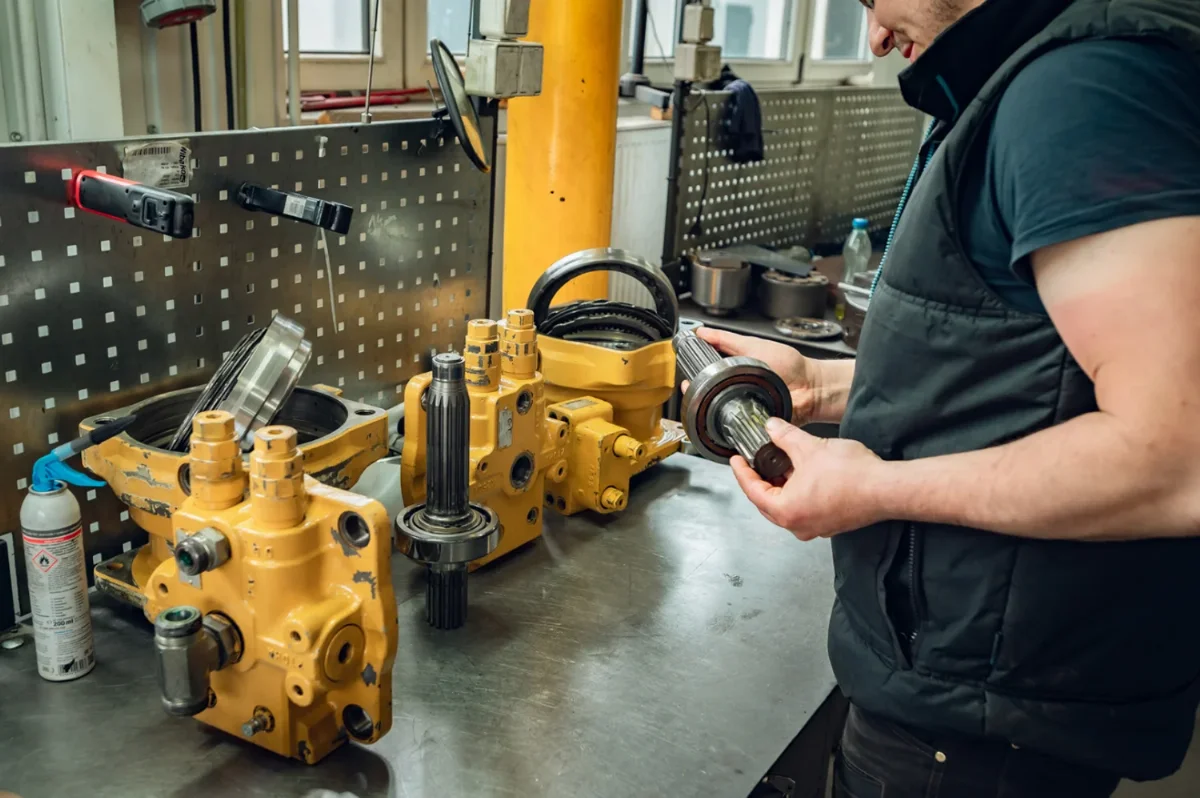
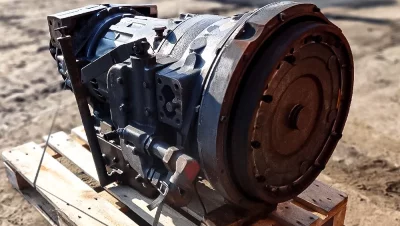
On crawler excavators the travel motor is usually an axial piston motor. It is bolted directly to the final drive, the planetary gearbox that drives the track sprocket. One assembly typically includes:
- a counterbalance valve that prevents the machine from rolling away,
- relief valves,
- a spring-applied, pressure-released multi-disc parking brake,
- a displacement change mechanism that provides two travel speeds.
Wheeled machines often use variable-displacement bent-axis motors driving a gearbox or axle.
The swing motor drives the swing reduction gear, whose pinion meshes with the slewing ring. In addition to the rotating group it has a parking brake, shock relief valves that limit pressure when the superstructure starts and stops, and anti-cavitation valves. It works cyclically, constantly accelerating and braking the heavy upper structure. That is why its wear shows up differently from that of a travel motor.
Symptoms of a failing hydraulic motor
Wear usually builds up gradually. The operator first notices a loss of power or speed, and only later noise and leaks. The sooner the machine is diagnosed, the better the chance that a rebuild will do instead of replacing the whole unit.
Travel motor
- lack of power on inclines or when counter-rotating, the machine “bogs down” under load,
- pulling to one side when travelling straight because one track is slower,
- no shift into high speed or dropping back into low speed by itself,
- jerking, or the machine creeping down a slope after the lever is released,
- rising oil level in the final drive or hydraulic oil in the gear oil,
- whining, knocking, housing noticeably hotter than on the other side.
Swing motor
- slow or uneven swing, weak start of the superstructure,
- a knock or noticeable play when the swing stops,
- the superstructure drifts on a slope with the lever released, which points to the brake,
- squealing, grinding, metal particles in the reduction gear oil.
Symptom – possible cause – what to do
- Pulling to one side: worn rotating group in one travel motor, leaking swivel joint, faulty relief valve or control valve section. What to do: measure the pressures in both travel circuits and the case drain flow of each motor. If the design allows, swap the supply lines between sides to rule out the pump and control valve.
- No high speed: no pilot pressure, stuck displacement change piston or faulty solenoid valve. What to do: measure the pilot pressure at the motor and check the solenoid power supply.
- Hydraulic oil in the final drive: damaged motor shaft seal. A frequent cause is excessive case pressure due to a blocked or kinked drain line. What to do: check the drain line is clear, replace the seal and the final drive oil, inspect the bearings.
- Rolling down a slope, swing drift: worn parking brake discs or springs, or a faulty counterbalance valve. What to do: measure the brake release pressure, dismantle the brake and measure the disc pack.
- Noise and metal particles: seized piston slippers, damaged valve plate, failed bearings. What to do: stop the machine, take an oil sample and inspect the filters. Continued operation spreads debris through the entire system.
Diagnostics: case drain leakage and pressure tests
The best indicator of a piston motor’s condition is internal leakage, i.e. the amount of oil leaving through the case drain line. Clearances develop between the pistons and the cylinder block and between the block and the valve plate. The larger they are, the more oil bypasses the working process and goes to drain, and the motor loses torque and speed. The test is carried out as follows:
- Warm the oil up to operating temperature.
- Disconnect the drain line from the tank, route it into a graduated container and plug the tank port.
- Load the motor to the relief valve setting by stalling the track or superstructure according to the manufacturer’s procedure. Measure the volume of oil over a set time.
- Compare the result with the permissible value in the service documentation and with the motor on the other side.
At the same time, measure:
- working and relief pressures of the circuits,
- speed change pilot pressure,
- brake release pressure.
It is also worth inspecting the filters and magnetic plugs. Brass particles point to piston slippers or bushings, steel particles to bearings or gear teeth. We described an example of such diagnostics in the case of a swing and rotator failure on a Liebherr LH35.
Hydraulic motor rebuild – inspection and machining
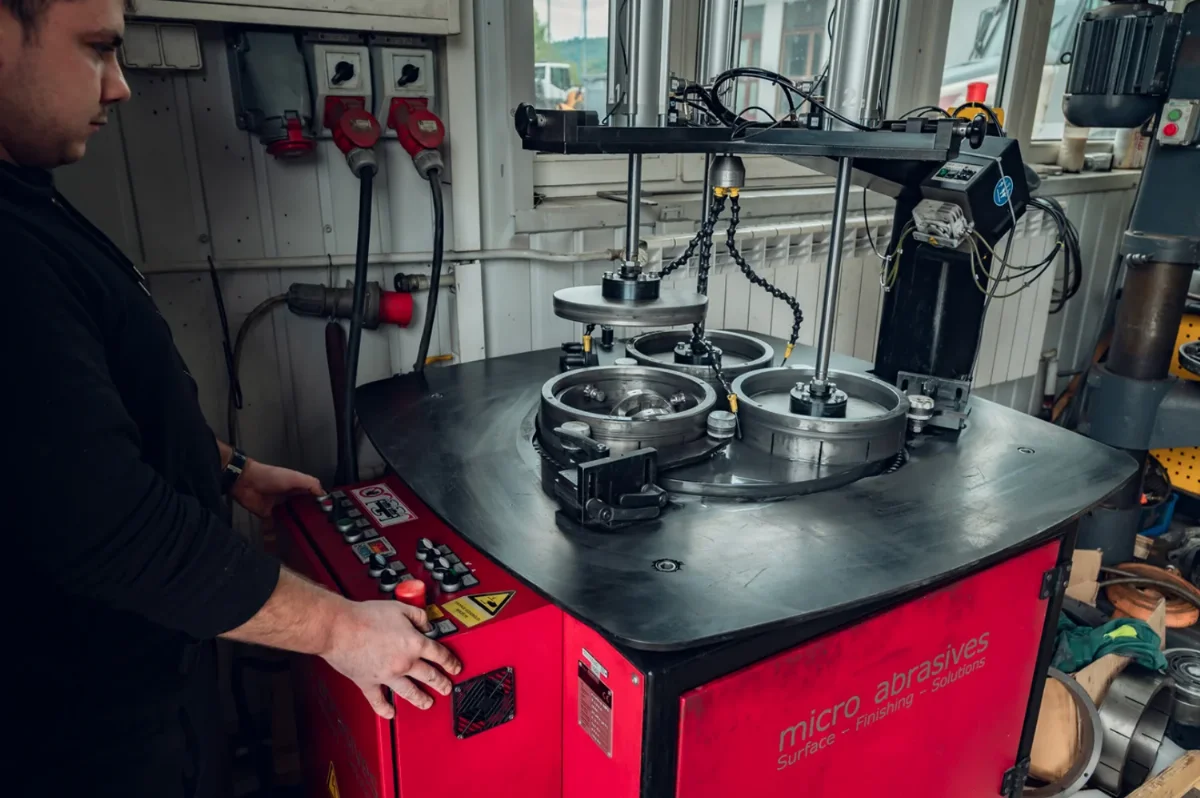
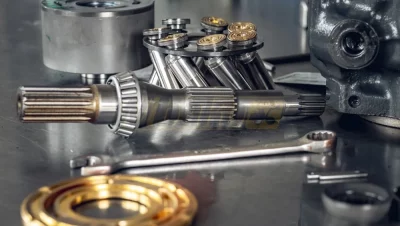
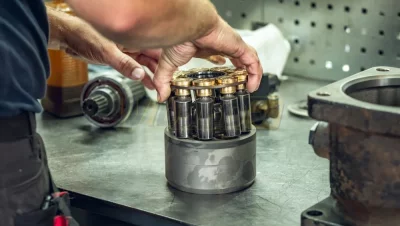
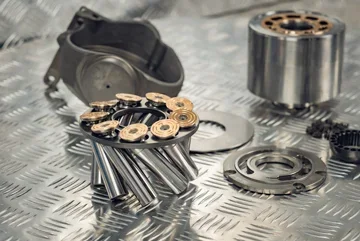
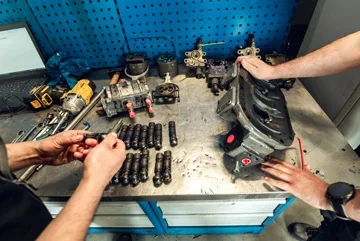
After removal the motor is cleaned and stripped down to individual parts. The inspection covers mainly:
- the valve plate and cylinder block face: scoring, pitting, signs of seizure,
- pistons with slippers: ball joint play, wear of sliding surfaces,
- the swashplate or thrust plate and the retainer plate,
- cylinder block bores, splined shaft and bearings,
- brake discs, springs, valves and the speed change piston.
The valve plate, block face and thrust plate are flat surfaces on which the oil forms a sealing film. With minor wear they are restored by lapping on a lapping machine. Parts worn beyond machining limits, as well as all seals and bearings, are replaced with new ones. The scope of replacement is determined after measurement and accounts for most of the cost.
Assembly and testing after the rebuild
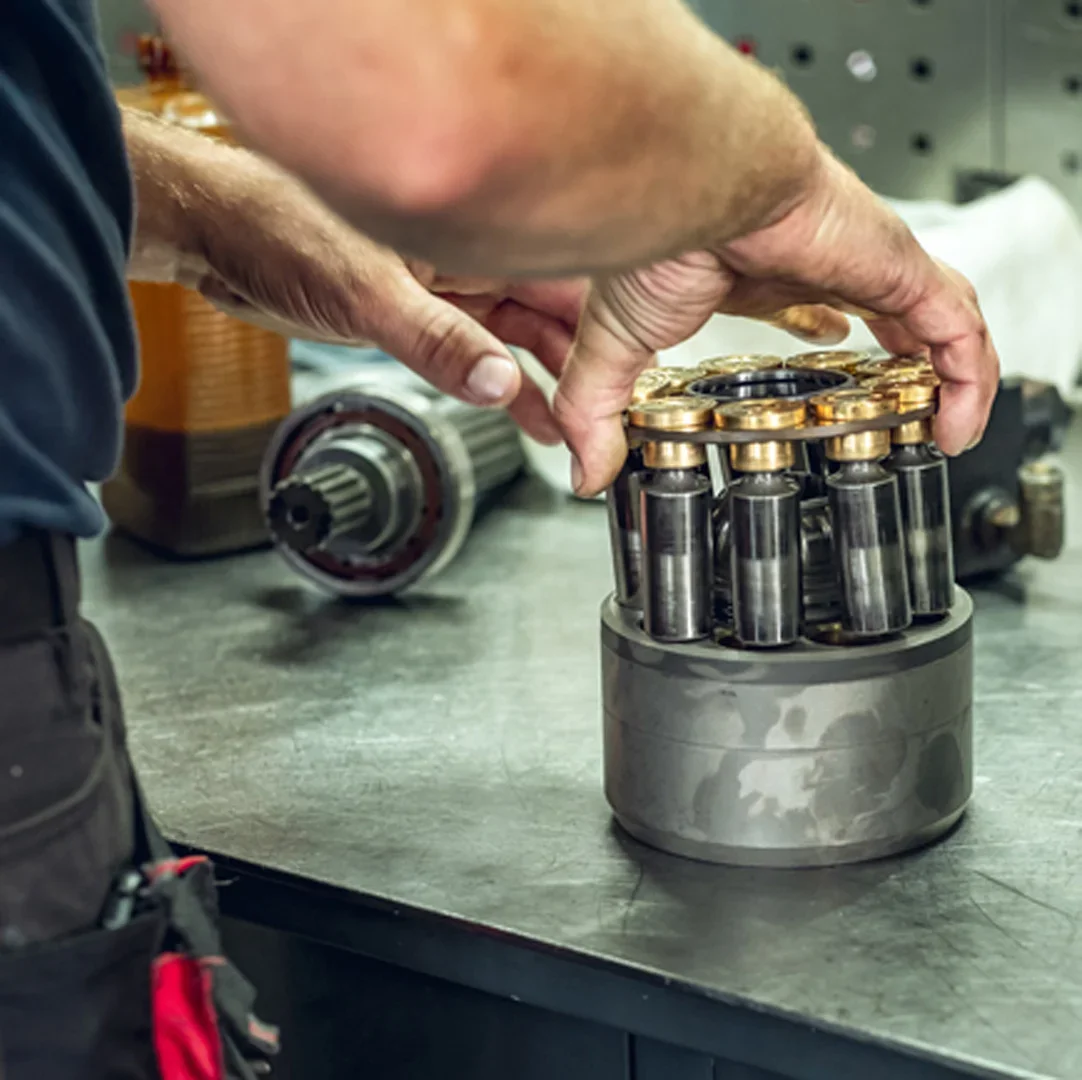
The motor is assembled with a new seal kit, observing tightening torques and valve settings. Before start-up the housing must be filled with oil through the drain port. A “dry” start can destroy freshly machined surfaces within the first minutes of operation. After installation on the machine, case drain leakage, pressures, speed shifting, brake function and operating temperature are checked.
Eliminating the root cause of the failure is just as important. If the motor wore out because of contaminated oil, the oil and filters must be changed, the lines flushed and the pump checked. Otherwise the rebuilt unit will soon share the fate of the old one. This is well illustrated by the story of a new final drive and a repeat failure on a Wacker Neuson ET18. The same applies to pumps, as shown in the DPVO 165 pump rebuild.
Common designs: Rexroth A6VM, Kawasaki M2X, Linde
The operating principle is the same, but designs differ in details that affect diagnostics and parts selection:
- Rexroth A6VM – variable-displacement bent-axis piston motor, used among others in travel drives of wheeled machines. Typical problems are valve plate and piston wear and a faulty displacement control.
- Kawasaki M2X – a series of swashplate swing motors fitted to many crawler excavators. The rotating group, parking brake and shock relief valves wear most often.
- Linde (HMF, HMV) – fixed- and variable-displacement piston motors found in travel drives and swing mechanisms.
Liebherr, Komatsu and Sauer-Danfoss motors are of similar design. Diagnostic and rebuild methods are the same; parts and service data differ.
Rebuild or replace the motor
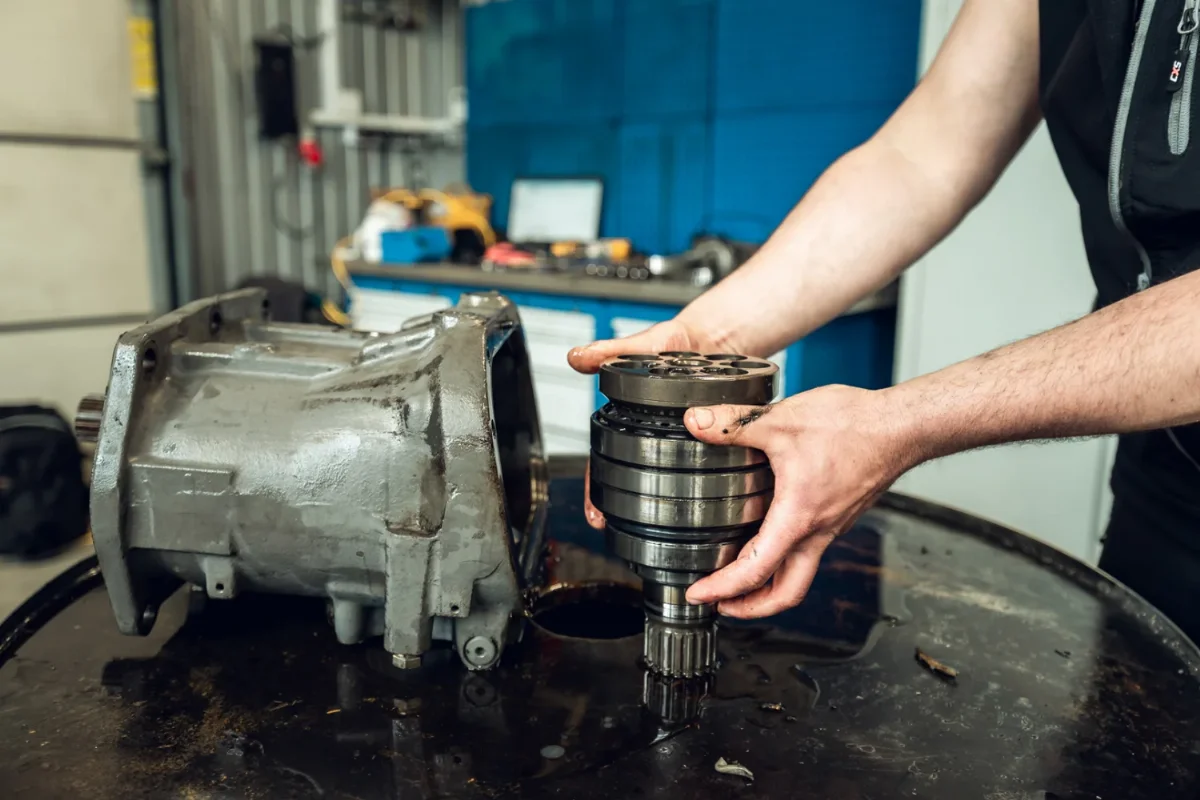
A rebuild makes sense when the housing, cylinder block and shaft are fit for further service and wear is limited to sliding surfaces, pistons, bearings and seals. A new or tested used motor is the better choice in three cases:
- the housing is cracked,
- the block bores are seized,
- the cost of rebuild parts approaches the price of a complete unit.
With a travel motor it is always worth checking the final drive at the same time, and with a swing motor the reduction gear and the slewing ring.
New and used drive components can be found in the drive train parts section. If the part you need is not in the shop, ask us about availability.
How much does hydraulic motor repair cost and how long does it take
There is no single price for repairing a travel or swing motor. The cost depends on several factors:
- extent of wear: replacing seals is a completely different scale from replacing the cylinder block with pistons and valve plate,
- availability and origin of parts: genuine, aftermarket or used,
- removal labour: the travel motor is usually removed together with the final drive or after separating it,
- additional work: final drive or reduction gear repair, system flushing, filter replacement.
Service work is charged at the following rates:
- mechanic labour hour: PLN 230 net per mechanic,
- labour hour for fitting parts purchased from WIBAKO: PLN 190 net,
- travel: PLN 3 net per km, charged both ways.
The cost of parts and machining is determined after inspecting the dismantled motor. Repair time depends mainly on parts availability. We can prepare a quote fastest if you provide the machine model, the number from the motor nameplate and a description of the symptoms. Get in touch with us.
Frequently asked questions
How much does hydraulic motor repair cost?
The cost depends mainly on the extent of wear: replacing seals is priced very differently from replacing the cylinder block, pistons and valve plate. Labour is PLN 230 net per mechanic hour, and travel is PLN 3 net per km both ways. The cost of parts and machining is determined after inspecting the dismantled motor.
How can I tell if an excavator travel motor is faulty?
The most reliable test is measuring case drain leakage with the motor loaded to the relief valve setting and comparing the result with the manufacturer’s data and with the motor on the other side. In addition, the travel circuit pressures, speed change pilot pressure and brake release pressure are measured.
Why is the oil level in the final drive rising?
The most common cause is a leaking travel motor shaft seal that lets hydraulic oil pass into the final drive. The seal is often damaged by excessive case pressure due to a blocked or kinked drain line, so the drain must be checked as well.
My excavator pulls to one side – is it definitely the travel motor?
Not necessarily. The same symptom can be caused by a leaking swivel joint, a faulty relief valve, a control valve section or the pump. Before removing the motor, the pressures and leakage of both travel circuits should be measured.
Rebuild or a new hydraulic motor?
A rebuild makes sense when the housing, cylinder block and shaft are fit for further service. Replacement is the better option if the housing is cracked, the block bores are seized or the cost of parts approaches the price of a complete motor.
Do you rebuild hydraulic motors of different brands?
We rebuild hydraulic pumps and motors for construction machinery. For a specific model it is best to ask us directly, giving the machine make and model and the number from the motor nameplate.