

The role of the piston and connecting rod in a diesel engine
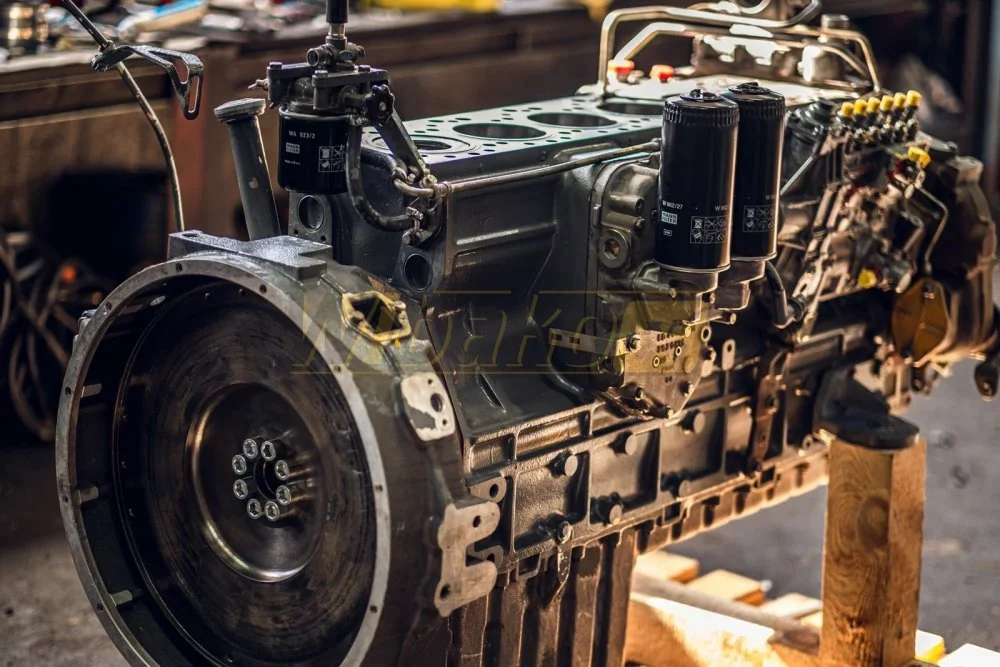
The piston and connecting rod form an assembly that converts combustion pressure into rotation of the crankshaft. In a construction machine diesel, cylinder pressure reaches well over 10 MPa. The piston crown is in direct contact with the flame, and the whole assembly runs for thousands of hours under heavy load, often in dusty conditions and with long periods of idling.
The piston seals the combustion chamber, transfers the gas force to the connecting rod and dissipates heat to the cylinder wall and the oil. The connecting rod passes this force on to the crankshaft and converts reciprocating motion into rotation. Wear on one component almost always affects the others, which is why an overhaul assesses the complete assembly: piston, rings, gudgeon pin, connecting rod, bearing shells and cylinder.
Diesel engine piston design
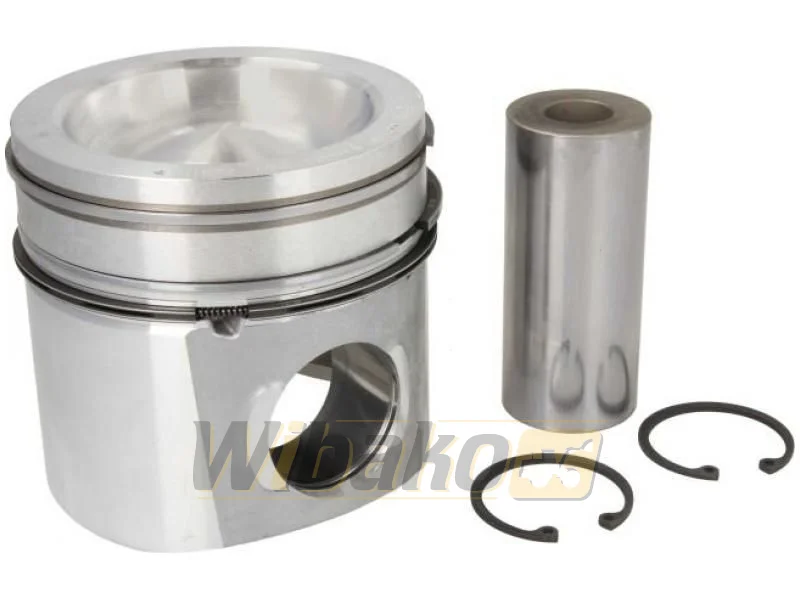
Pistons for construction machinery engines are most commonly cast from an aluminium-silicon alloy. Heavily loaded engines may also use steel or two-piece (articulated) pistons. A typical piston consists of several zones:
- Crown with combustion bowl – in direct injection engines the combustion chamber is machined into the piston (usually omega-shaped). It shapes the air swirl and the combustion of the fuel charge.
- Ring belt – three grooves: two for compression rings and one for the oil control ring. The top ring groove is usually reinforced with a cast-in iron insert, as it runs at the highest temperature.
- Piston skirt – the guiding section that transfers side thrust to the cylinder bore. It has a slightly oval, barrel-shaped profile and often an anti-friction coating (e.g. graphite).
- Pin bosses – bores for the gudgeon pin, which is secured with circlips.
- Cooling gallery – an annular channel below the ring belt, supplied with oil by jets in the block.
Piston cooling jets spray oil from below into the cooling gallery. A blocked, bent or incorrectly seated jet is a common cause of overheating and crown cracking. Every overhaul should include a check that the jets are clear and correctly aligned.
Piston rings – compression and oil control
In diesels, the top compression ring usually has a keystone (trapezoidal) cross-section. The piston's lateral movement then helps prevent carbon build-up in the groove. The second ring (often taper-faced or Napier-type) provides additional sealing and helps scrape oil. The third, the oil control ring, has an expander spring and slots through which excess oil from the bore returns to the sump.
Symptoms of worn piston rings
- heavy blow-by from the crankcase breather, oil being pushed out past the dipstick or filler cap,
- increasing oil consumption with no visible leaks,
- blue smoke, especially after start-up and under sudden acceleration,
- loss of compression on one or more cylinders, harder starting and reduced power.
Blue smoke can also have other causes, such as the turbocharger or valve stem seals. Before stripping the engine, it is worth working through the diagnostics described in our guide Why is my machine blowing blue smoke?. A compression test, a cylinder leak-down test and an endoscope inspection through the injector bore usually show clearly whether the problem lies with the rings and the bore.
Connecting rod – design, small end bush and bearings
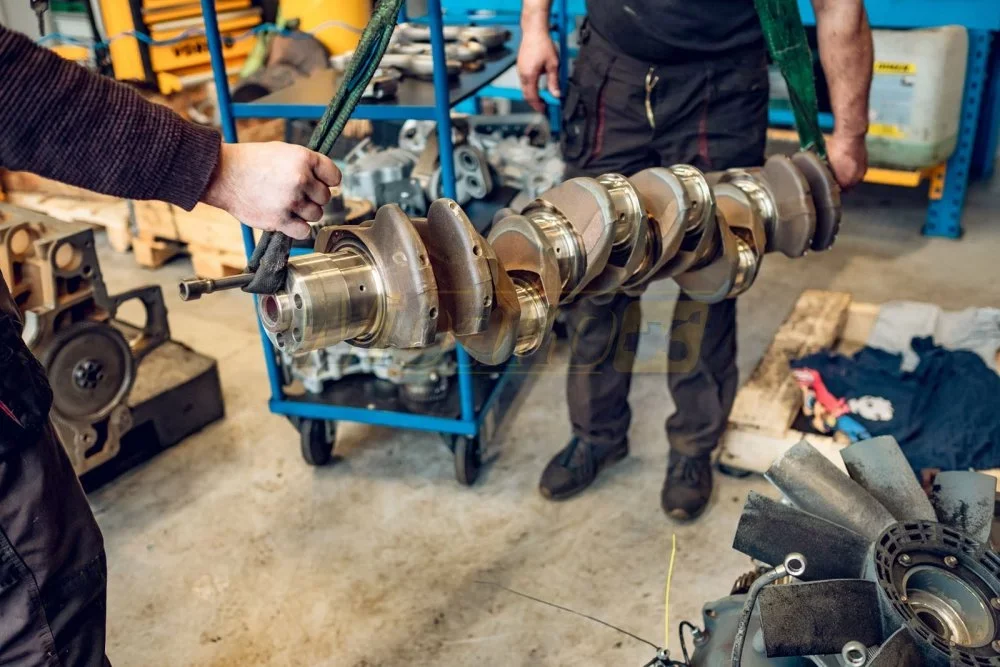
A connecting rod is a forged steel beam with an I-section, made up of three parts:
- small end – with a pressed-in bush (usually bronze) in which the gudgeon pin rotates. A lubrication hole or channel leads to the bush, and in some engines a drilling along the shank supplies oil from the crankshaft,
- shank – carries compressive and tensile forces,
- big end with cap – clamps around the crankpin via two big end bearing shells.
The big end cap may be separated by cutting and machining or by fracture splitting (controlled cracking). On fracture-split rods, the uneven parting surface centres the cap by itself. The cap must not be swapped, turned round, or have its parting face ground. Large diesels often use an angled big end split so the rod can pass through the cylinder when fitted from above. Connecting rod bolts are usually torque-to-yield, single-use bolts tightened to a torque and angle specified by the manufacturer. Bearing shell and journal condition is covered in more detail in the article Crankshaft and bearings – design, damage and reconditioning.
Typical piston damage and its causes
- Scuffed or seized skirt – engine overheating, lack of oil or oil diluted (e.g. with fuel), insufficient fitting clearance, overloading a cold engine.
- Burnt crown or bowl edge – a dribbling or poorly atomising injector, over-advanced injection timing, excessive fuel delivery.
- Cracked crown – thermal overload, faulty piston cooling jets.
- Abrasive wear of the ring belt – dust drawn in through a leaking intake or damaged air filter.
- Coked, stuck rings and glazed bores – prolonged idling without load.
- Bent connecting rod – water or coolant drawn into the cylinder (hydrolock).
Replacing the piston without eliminating the cause leads to a repeat failure. With a burnt crown, check the injectors and the injection pump; with seizure, the cooling and lubrication systems; with abrasive wear, the integrity of the intake.
STD size and oversizes – how to choose a piston
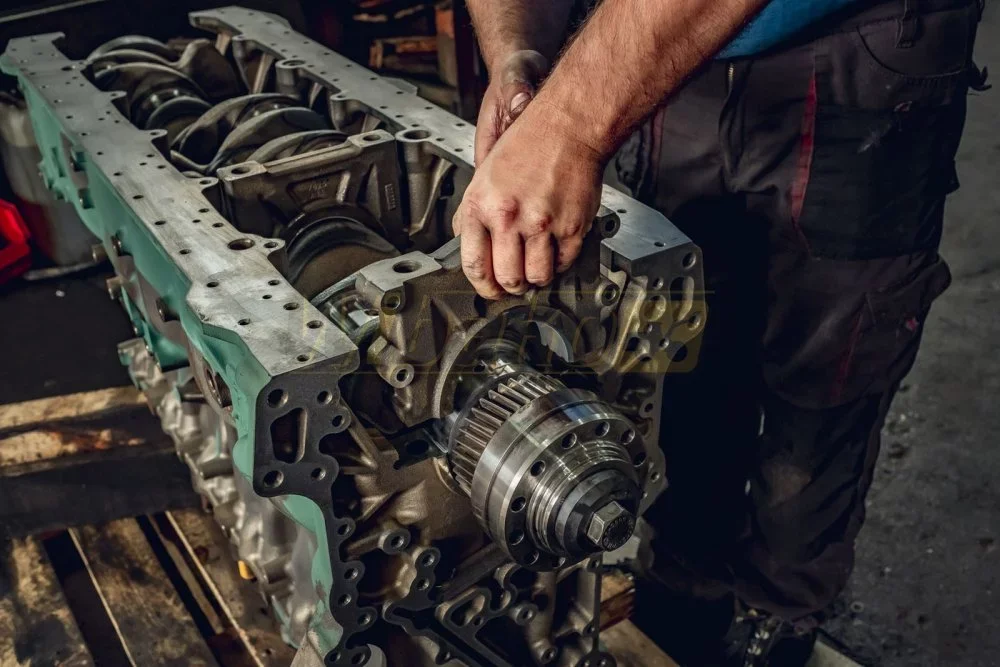
STD refers to the nominal diameter specified by the manufacturer. Oversizes, most commonly 0.25 and 0.50 mm, are used in parentless-bore engines where the cylinder is machined directly into the block: after boring and honing the cylinder, a larger piston with matching rings is fitted. In engines with replaceable liners (wet or dry), the liner is usually replaced, and when a block is sleeved the cylinder returns to its nominal size. In both of these cases an STD piston is used.
Before ordering and fitting, check:
- cylinder diameter, ovality and taper, as well as piston-to-bore clearance,
- ring end gap in the bore and ring side clearance in the grooves,
- piston protrusion above the block deck – on many engines this determines the head gasket thickness,
- the piston part number and engine version (combustion bowl and compression height differ between variants),
- connecting rod condition: straightness, parallelism of the bores, big end ovality and small end bush clearance.
Parts and engine overhauls at WIBAKO
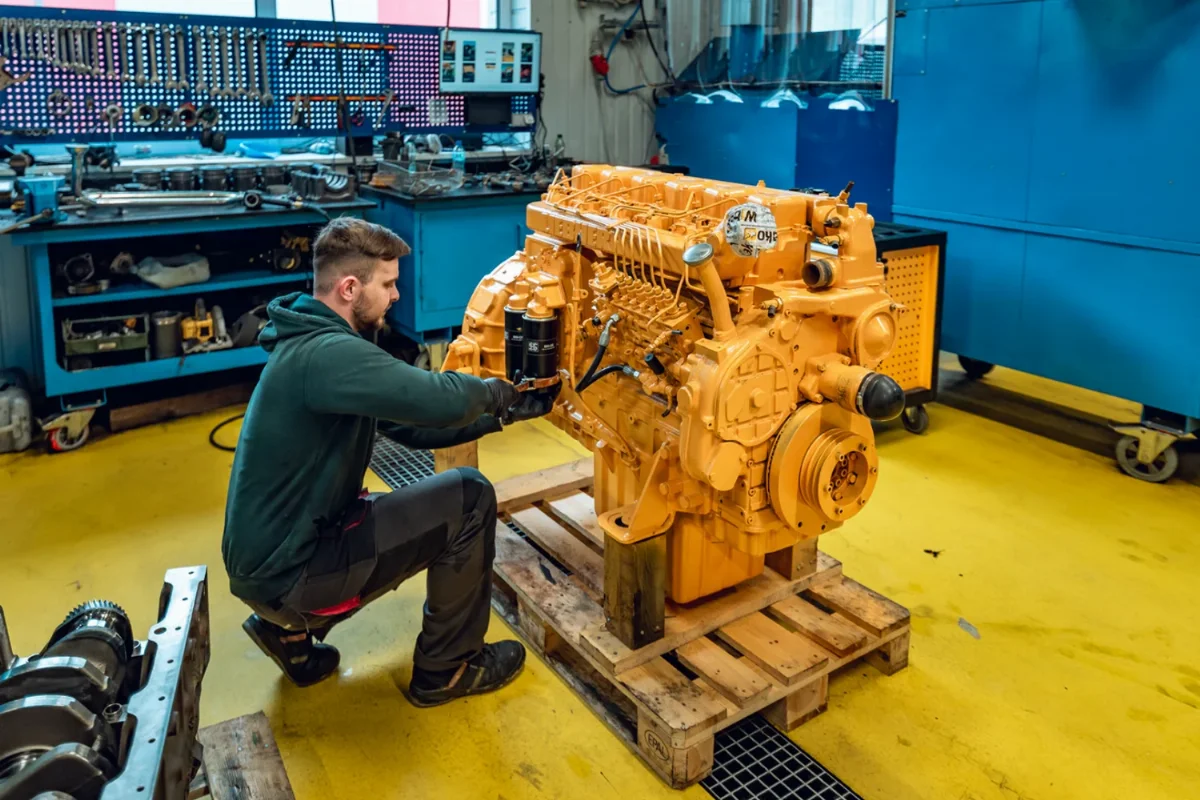
The WIBAKO shop stocks pistons for construction machinery engines, including the Kolbenschmidt STD piston ⌀101 mm and the Deutz 1013/2013 piston, as well as rings, liners, connecting rods and bearing shells. An overview of the available part groups can be found in the article Engine parts for construction machinery. The most reliable way to select a piston is by engine serial number or the part number. If in doubt, contact us with the engine type and serial number.
If wear affects the entire piston and connecting rod assembly, we carry out diesel engine repairs and complete overhauls: from disassembly and measurement, through machining and sourcing parts, to final engine assembly. When fitting parts purchased from WIBAKO, the labour rate is PLN 190 net per hour. The scope of work and lead time are agreed individually after diagnosis.
Frequently asked questions
What connects the piston to the crankshaft?
The piston is connected to the crankshaft by the connecting rod. The small end sits on the gudgeon pin (usually via a bronze bush), while the big end clamps around the crankpin via the big end bearing shells.
What is the difference between an STD piston and a 0.50 oversize piston?
An STD piston has the nominal diameter specified by the engine manufacturer. A 0.50 oversize piston is 0.50 mm larger and is used in a cylinder bored and honed to that size. After sleeving, the cylinder returns to its nominal size, so an STD piston is fitted.
What are the symptoms of worn piston rings?
Typical symptoms include increased crankcase blow-by, oil loss, blue smoke (especially after start-up and under acceleration) and loss of compression and power. This is confirmed with a compression test, a cylinder leak-down test or a blow-by measurement.
Can I replace just the rings without replacing the pistons and liners?
Only if the cylinder and piston ring groove measurements are within the manufacturer's tolerances and the bore still has its cross-hatch honing pattern. New rings in an oval or glazed bore will quickly stop sealing.
What is a piston skirt?
The skirt is the lower, guiding section of the piston that transfers side thrust to the cylinder wall. It has a slightly oval, barrel-shaped profile and often an anti-friction coating, so its wear pattern is a good indicator of whether the piston has been running correctly.