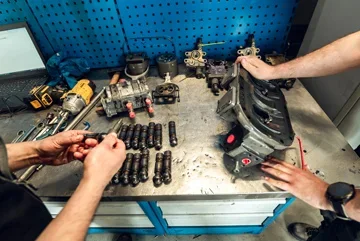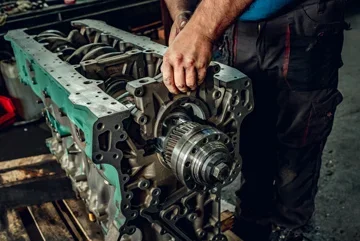


The crankshaft is one of the most heavily loaded components of a diesel engine in an excavator, wheel loader or crane. It carries the forces from every cylinder and runs for thousands of hours under full load, and its service life depends almost entirely on the condition of the bearings and the quality of lubrication. Below we explain how an engine crankshaft is built, what main, con rod and thrust bearings do, how to recognise bearing wear, and when a crankshaft is worth regrinding and when it should be replaced.
What a crankshaft is and what it does
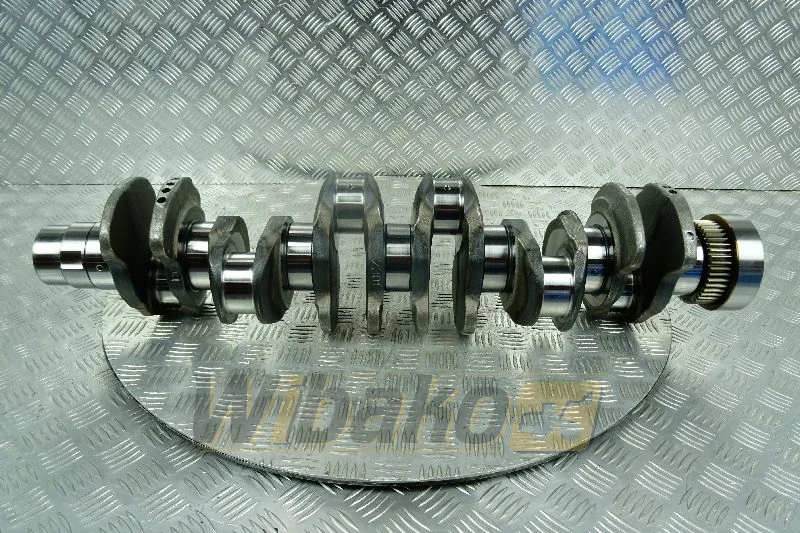
The crankshaft converts the reciprocating motion of the pistons into rotation. Combustion pressure pushes the piston down, the connecting rod transfers this force to the crank throw, and the shaft turns, delivering torque through the flywheel to the clutch, torque converter or hydraulic pump. At the front, the crankshaft usually drives the timing gear, the torsional vibration damper and the engine accessories.
A common question is how the camshaft differs from the crankshaft. The camshaft operates the valves and turns at half crankshaft speed. The crankshaft transmits the full power of the engine, which is why it is far more massive and supported in several plain bearings.
Crankshaft design
- Main journals – lie on the shaft axis and rotate in the main bearing saddles of the engine block, in the main bearing shells.
- Crankpins (rod journals) – offset from the axis; the connecting rods with their con rod bearings run on them.
- Webs and counterweights – connect the journals and balance inertial forces, reducing vibration and bearing loads.
- Oil passages – drillings that carry oil from the main journals to the crankpins. Keeping them clear is essential for lubricating the con rod bearings.
- Fillet radii – the rounded transitions between journal and web. These are the points of highest stress concentration and the most common starting point for cracks.
Construction machinery engines mostly use forged alloy steel crankshafts with high fatigue strength. Cast crankshafts made of ductile (nodular) iron are found in smaller engines. Journal surfaces are induction hardened or nitrided – which matters a great deal when it comes to regrinding later on.
Main, con rod and thrust bearings
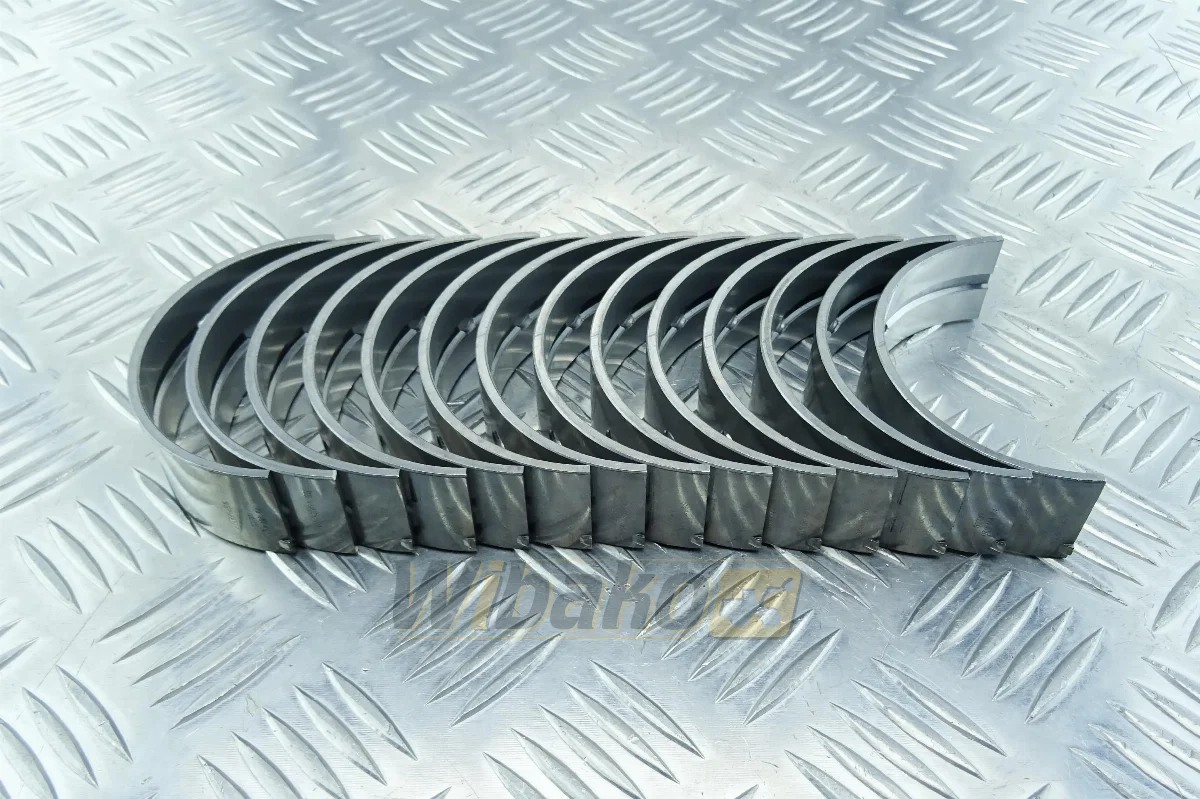
Bearing shells are thin-walled plain bearings: a steel backing, a layer of bearing alloy (e.g. lead bronze or aluminium alloy) and a thin overlay. The crankshaft never touches the bearing directly – it rides on an oil wedge maintained by oil pressure and the correct clearance.
- Main bearings – support the crankshaft in the block. The upper half usually has an oil hole and groove, while the lower half (in the cap) is often plain.
- Con rod bearings – sit in the big end of the connecting rod and take the highest shock loads.
- Thrust bearings – thrust washers (half rings) or flanged bearing shells on one of the main journals. They locate the crankshaft axially and absorb axial forces, e.g. from the clutch or transmission.
Thrust bearings limit crankshaft end play, which is measured with a dial gauge while levering the shaft back and forth with a pry bar. The limit value is given in the engine documentation. When fitting thrust washers, the oil grooves always face the crankshaft web (the rotating surface), with the plain side against the block. Fitting them the other way round leads to seizure within a few hours.
Bearings are available in the nominal STD size and in undersizes, usually 0.25, 0.50, 0.75 and 1.00 mm, selected to match the crankshaft after grinding. Reputable manufacturers such as Kolbenschmidt offer complete size ranges for popular engines – we covered our deliveries of this brand in the article New delivery of Kolbenschmidt engine parts at Wibako.
Symptoms of crankshaft and bearing damage
- Knocking – a dull, metallic knock under load points to the main bearings; a knock that changes when injection is cut on a given cylinder suggests a con rod bearing.
- Low oil pressure, especially with a hot engine at idle – excessive bearing clearance lets oil escape. We cover this in more detail in our guide Low engine oil pressure.
- Metal particles in the oil and filter – copper-coloured or grey metallic debris is usually bearing material.
- Excessive end play – leaks from the rear crankshaft seal, crankshaft position sensor faults, flywheel movement.
Shut the engine down at the first sign of knocking. Continued operation leads to a spun bearing, a seized journal and, in extreme cases, a broken connecting rod and a destroyed block.
Most common causes of damage
- Lack of lubrication – low oil level, worn oil pump, clogged oil pickup screen, operation on steep slopes.
- Contaminated oil – dust entering through a leaking intake or damaged air filter, extended oil change intervals, coolant or fuel in the oil thinning the oil film.
- Overheating – loss of oil viscosity and collapse of the oil wedge.
- Assembly errors – wrong tightening torque, reused stretch bolts, swapped bearing caps, dirt behind the bearing shell, misaligned oil holes.
- Failed torsional vibration damper – torsional vibration causes fatigue cracks in the crankshaft, usually at a fillet radius.
Crankshaft inspection
After removal, the crankshaft must be fully inspected before deciding what to do with it:
- Journal diameter measurement with a micrometer in several planes – to determine wear, out-of-roundness and taper.
- Runout measurement on V-blocks or between centres with a dial gauge, at the centre main journal.
- Hardness testing of the journal surfaces – especially after overheating (blue discolouration) and before grinding nitrided crankshafts.
- Crack testing using magnetic particle inspection, particularly at the fillet radii and around the oil holes.
- Oil passage check – flushing and verifying that they are clear.
The main bearing bores in the block and the con rod big ends are measured at the same time, because even a new bearing shell in an oval housing will not give the correct clearance.
Regrinding and reconditioning or replacing the crankshaft
Regrinding to an undersize makes sense when the crankshaft is not cracked, the runout is within correctable limits and a sufficient hardened layer remains after machining. After grinding, the journals are polished, the fillet radii restored and the oil holes chamfered, then bearings of the right size are selected and the oil clearance is checked.
Replacement is necessary when:
- the crankshaft is cracked,
- wear exceeds the last undersize,
- hardness has dropped after seizure or the material has been overheated,
- a nitrided crankshaft would need re-nitriding after grinding and the cost approaches the price of a new shaft.
A used crankshaft can be a good alternative, but only after measurement and crack testing – "nice-looking" journals alone guarantee nothing.
Crankshafts and bearings at the WIBAKO shop
In our shop you will find new and used crankshafts and bearings for construction machinery engines – including the BF Original STD crankshaft, the Deutz crankshaft, as well as Kolbenschmidt main, con rod and thrust bearings in STD and undersizes. For a full overview of our range, see Engine parts for construction machinery. If you are not sure about the part number, send us the engine type and serial number – we will help you find the right component.
Engine overhaul at WIBAKO
A damaged crankshaft is usually a sign that the problem affects the whole engine – the lubrication, cooling or air filtration system. As part of our diesel engine repair and overhaul service, we inspect the crankshaft, block and connecting rods, select the bearings, assemble the engine and eliminate the root cause of the failure so that it does not recur after a few hundred operating hours. Contact us to discuss the scope of the repair.